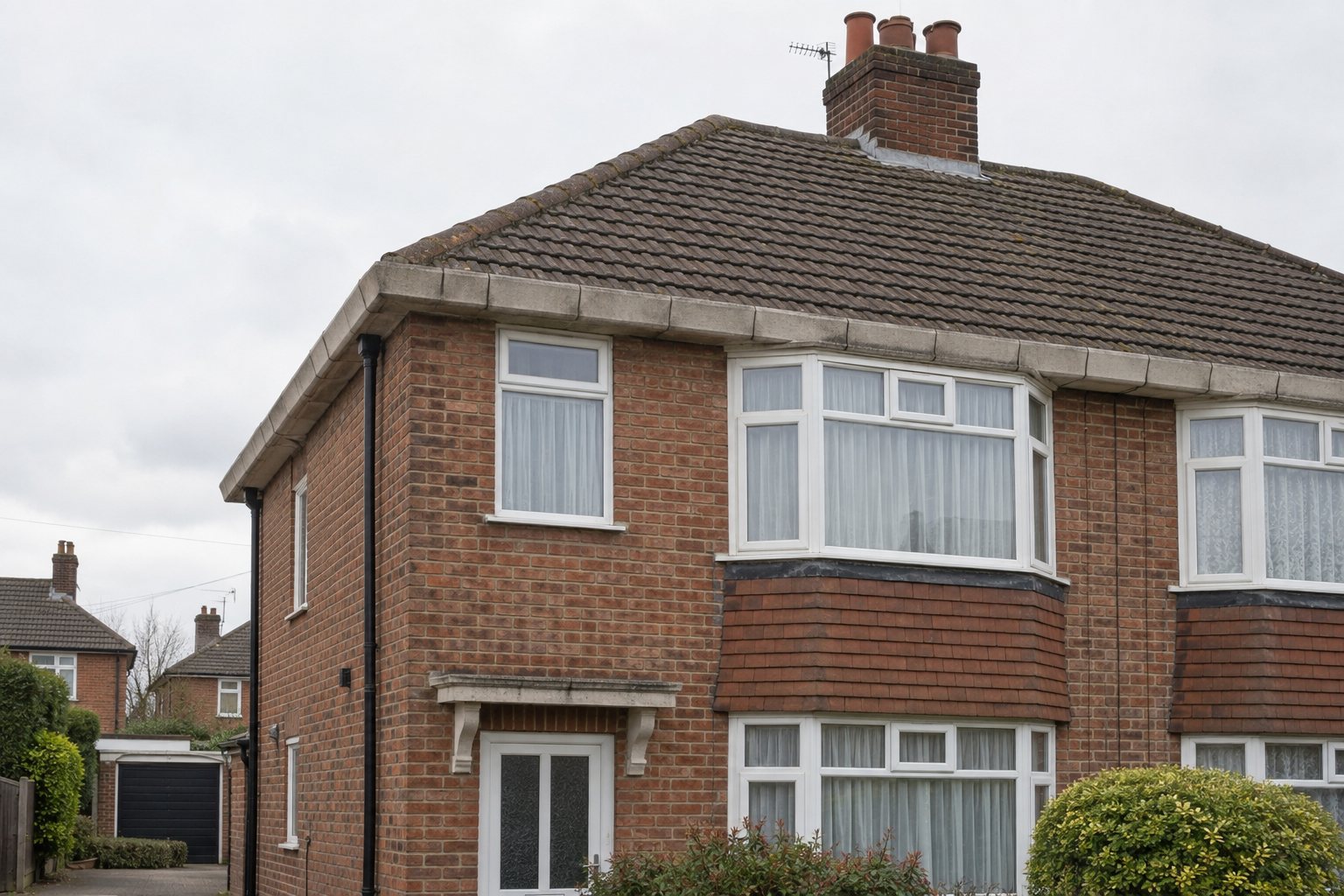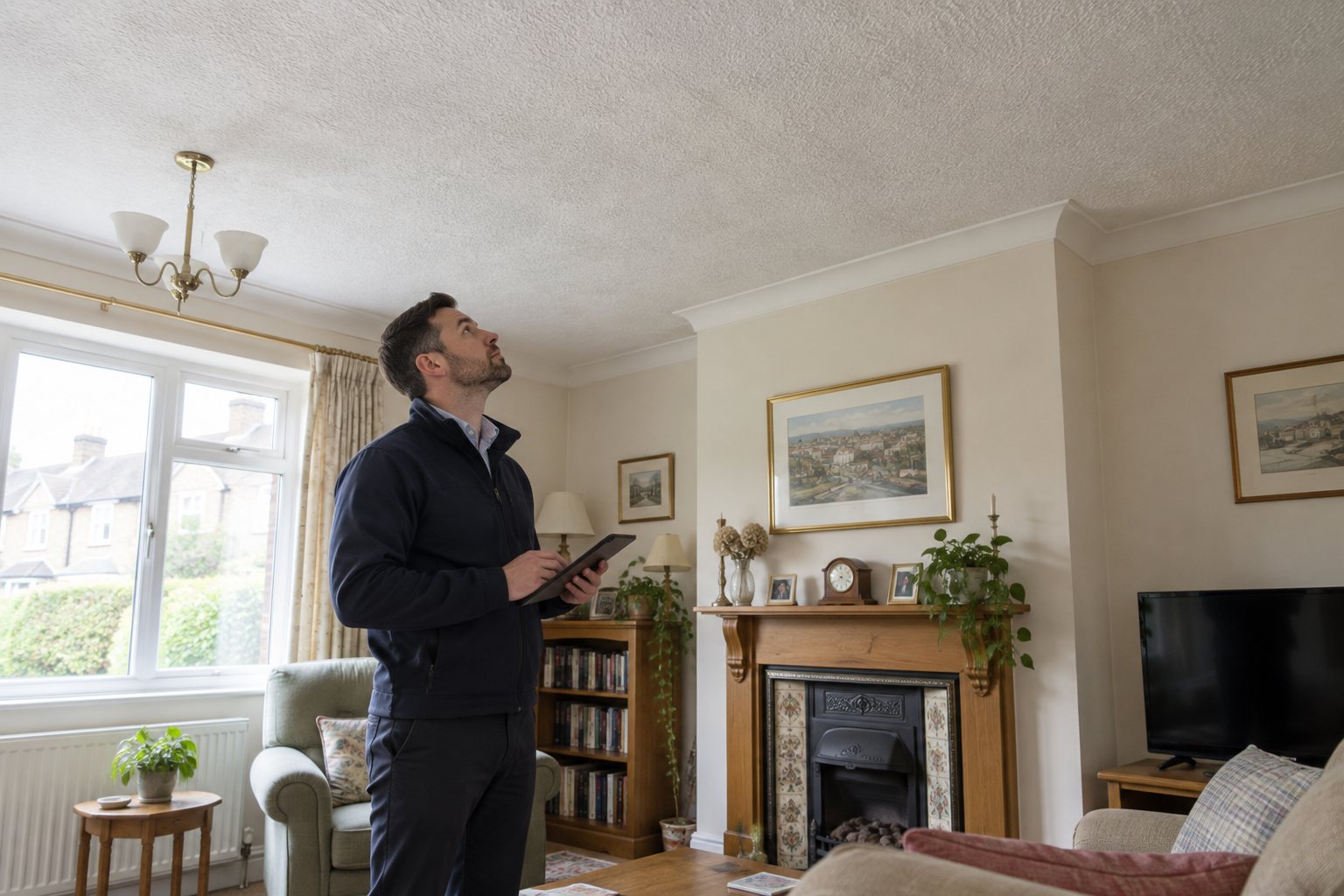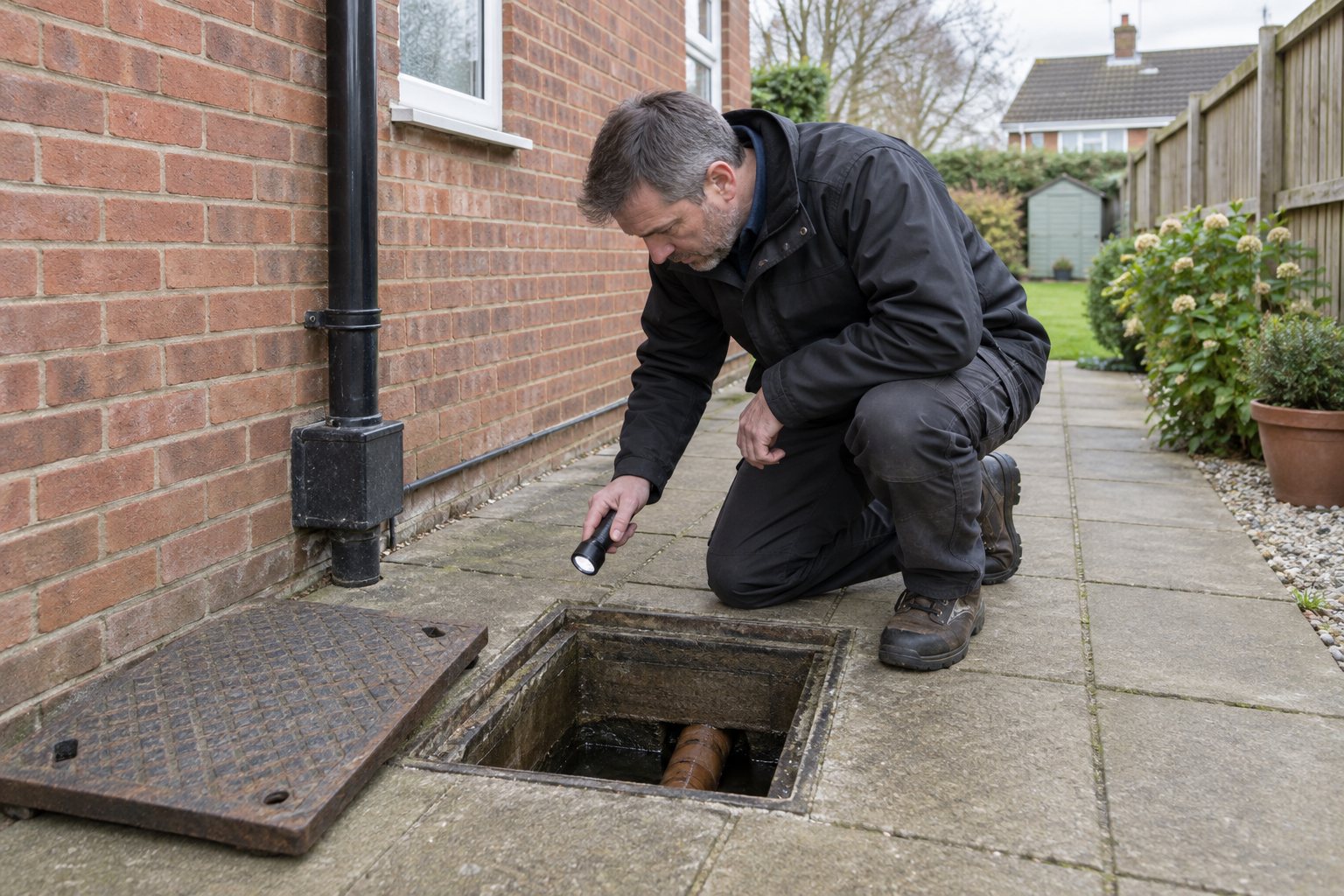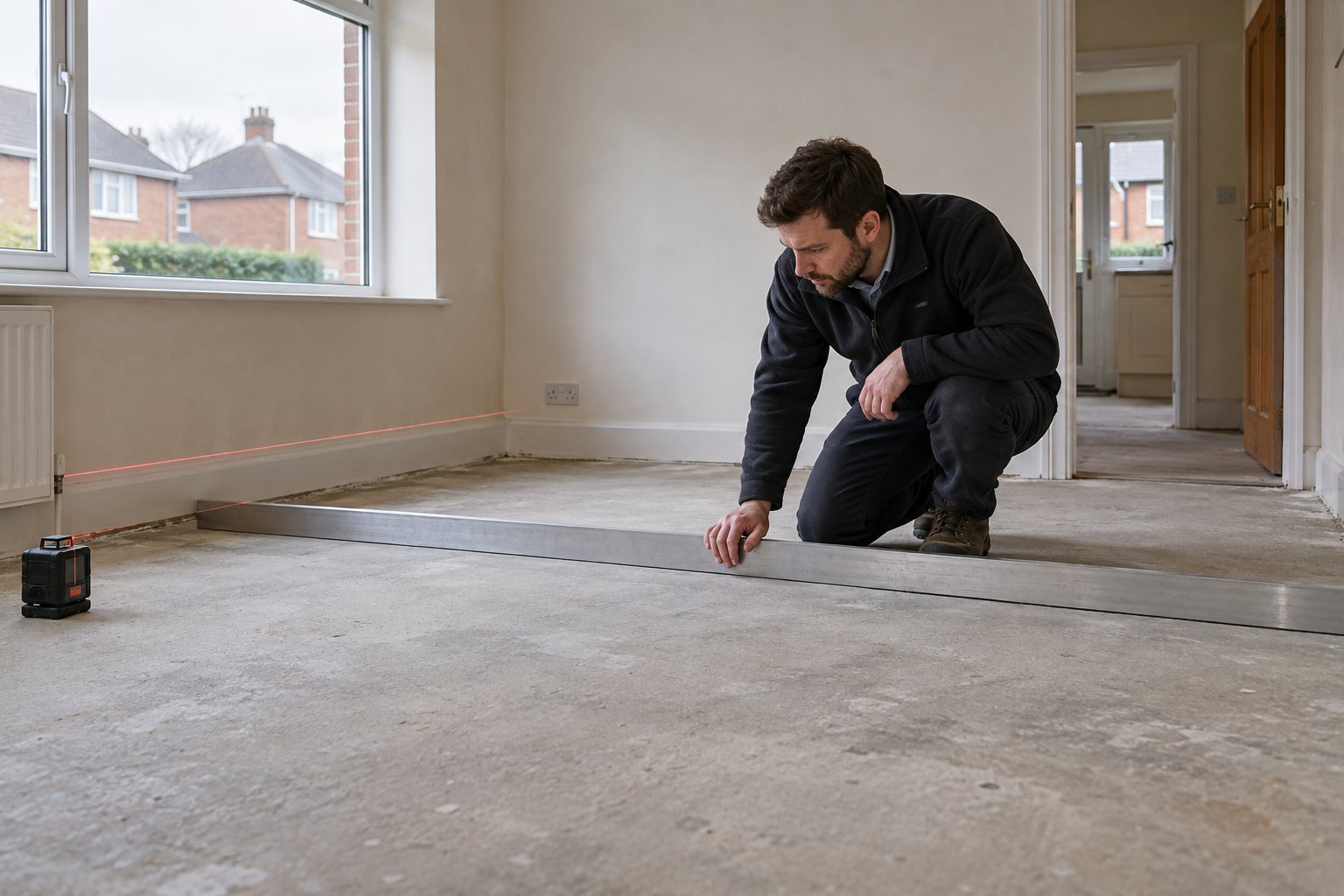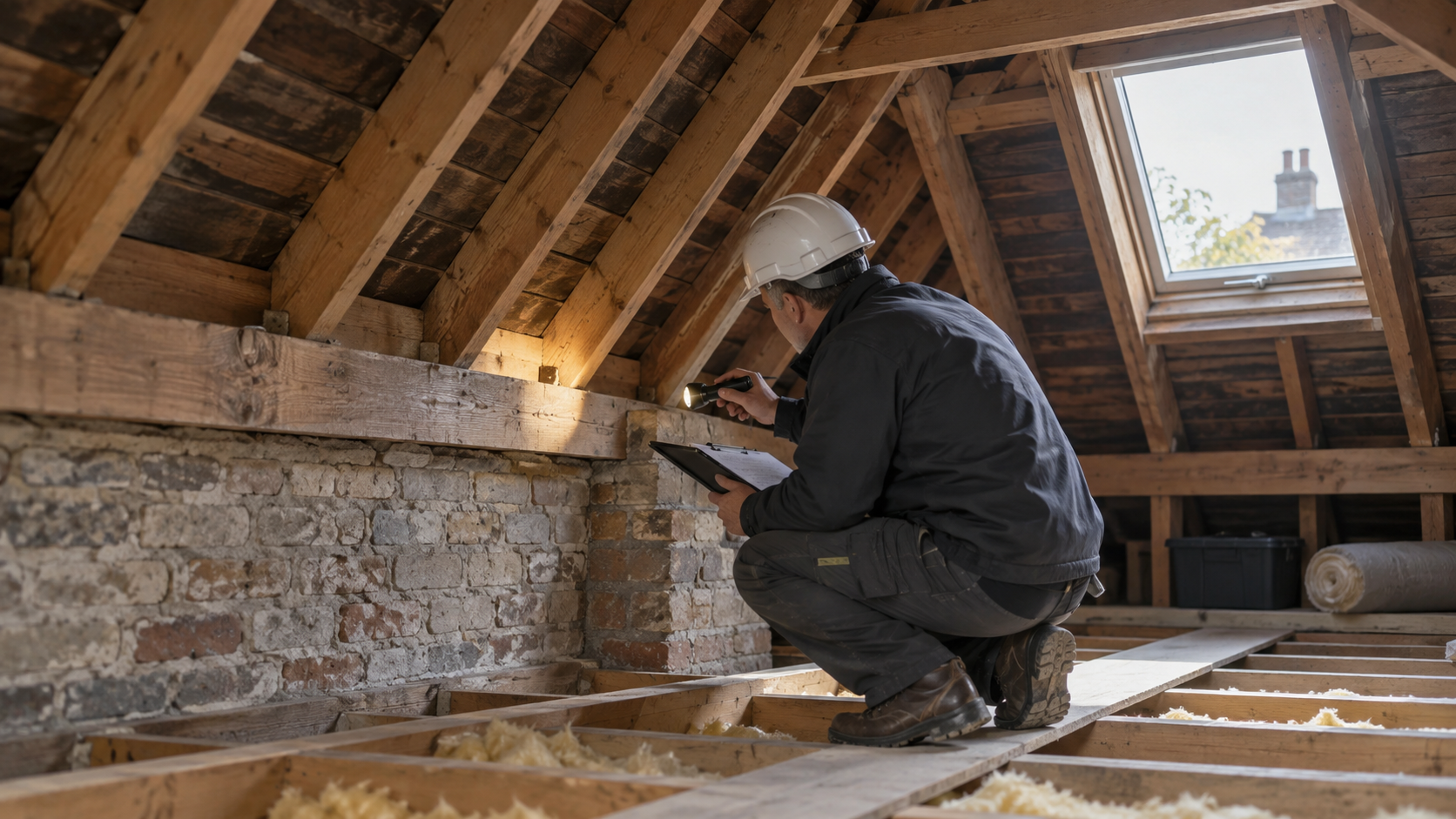

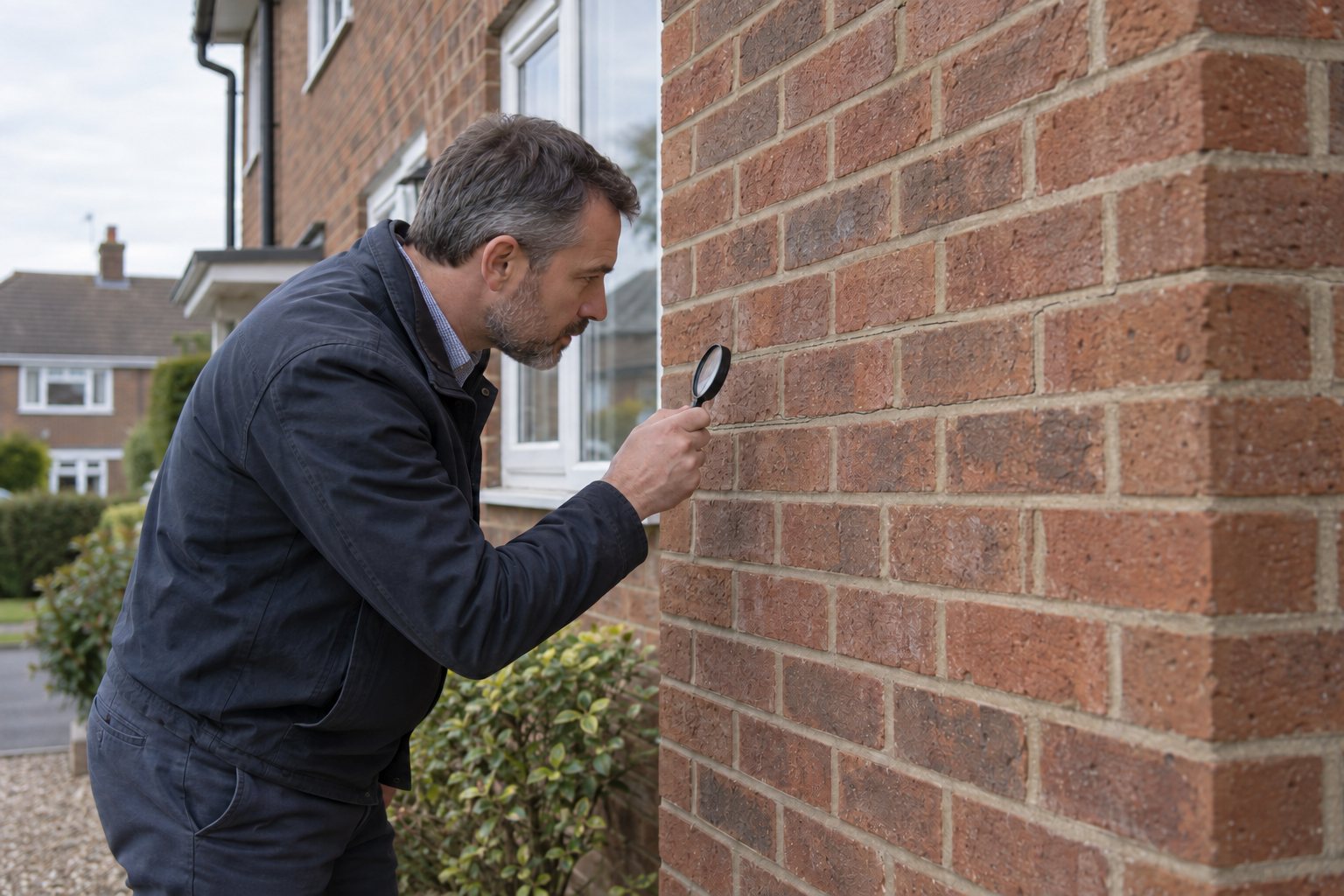
Wall tie failure can sometimes produce horizontal cracks, bulging brickwork or water penetration, but those symptoms do not confirm the diagnosis on their own. A chartered surveyor can assess the visible pattern, construction and level of risk, then advise whether a specialist cavity wall tie survey is needed. Because wall ties are concealed inside the cavity, confirming their type, number and condition may require a metal detector, borescope and, in some cases, carefully controlled opening-up.
In short
- Wall ties connect the inner and outer leaves of a cavity wall.
- Older steel wall ties may corrode; ties can also be missing, poorly installed or unsuitable for the construction.
- Regular horizontal cracking and wall distortion are recognised warning signs, but other defects can look similar.
- A normal home survey is principally visual and does not expose hidden ties.
- Specialist investigation can locate representative ties and assess their type, density and condition.
- Repair must be designed for the actual wall, cavity, exposure and masonry; there is no universal replacement specification.
What are wall ties and why do cavity walls need them?
A traditional cavity wall has two separate masonry leaves with a gap between them. The outer leaf is usually brick or blockwork exposed to the weather; the inner leaf forms part of the internal structure. Wall ties span the cavity and are embedded in a mortar joint on each side, connecting the leaves so that they resist forces such as wind safely together.
The ties are hidden once construction is complete. This is why a wall may appear generally sound while the metal components inside it are ageing — and why a crack seen from outside is not enough to determine tie condition.
Different periods and forms of construction used different tie materials, protective coatings and details. Modern work commonly uses stainless steel or other approved corrosion-resistant systems, but an existing building must be judged by what is actually present, not by assumptions based solely on age.
What does wall tie failure mean?
The term is used for several related problems. It may describe wall tie corrosion that has significantly reduced a tie’s performance, corrosion that is expanding and disrupting the surrounding masonry, or an inadequate connection caused by too few ties, poor embedment or defective workmanship.
Corrosion of older steel wall ties
BRE research found that some steel ties manufactured before 1981 could corrode prematurely because the service life of older protective coatings was sometimes shorter than the expected life of the wall. This is useful risk context, not a cut-off date: not every pre-1981 tie has failed, and a later house is not immune to installation defects.
When mild steel corrodes, rust occupies more space than the original sound metal. Where a tie is tightly embedded in a bed joint, this expansion may lift or split the mortar and disturb nearby brick. Continued loss of metal can also reduce the connection between the two leaves.
Missing or poorly installed ties
Cavity wall tie failure is not always caused by rust. A wall can be inadequately restrained because ties are absent, too widely spaced, poorly embedded, installed at an unsuitable angle or not properly fixed around openings. An alteration may also change how a wall is supported.
The distinction matters. Installing remedial wall ties may be appropriate in one case, while another needs masonry reconstruction, lateral restraint work or a different structural solution.
What causes wall ties to corrode or perform poorly?
Condition is influenced by a combination of material, moisture, workmanship and exposure. Factors a surveyor or specialist may consider include:
- the age and construction of the cavity walls;
- the material and protective coating of the original ties;
- persistent moisture within the cavity;
- aggressive mortar, including some historic mortars containing ash;
- exposure to driving rain or salts;
- mortar droppings or debris bridging the cavity;
- insufficient embedment or poor-quality mortar around the tie;
- inappropriate tie type, spacing or length;
- later cavity insulation that conceals ties or changes moisture behaviour;
- alterations to openings, roofs or floors that affect lateral restraint.
No single item proves failure. For example, a house in an exposed location may have serviceable ties, while a sheltered elevation can still contain poorly installed ones.
Warning signs: what might be visible?
Some patterns are more suggestive than others, but visual evidence needs to be interpreted in context.
| Visible observation | Why it may matter | Other possible explanations or next step |
|---|---|---|
| Regular horizontal cracking along bed joints | Corroding ties can expand within the mortar and create a repeating horizontal pattern | Thermal or moisture movement can also affect joints; map the pattern and investigate representative ties |
| Bulging or bowing of the outer leaf | May indicate loss of restraint or continuing expansion around ties | Can also relate to poor construction, loading, floor or roof restraint and local masonry defects |
| Cracked, spalled or displaced bricks | May show local stress around a corroding tie | Frost damage, impact, embedded metal and water penetration are alternatives |
| Damp or leakage through masonry | Moisture can contribute to corrosion and enter through cracks | Defective pointing, gutters, render, sills and cavity bridging must also be considered |
| Rows of filled drill holes | May indicate earlier cavity wall tie replacement | Obtain the specification, test records and guarantee; holes alone do not prove a suitable repair |
| Movement near windows or roof level | Ties and edge restraint may be relevant around openings and verges | Lintel movement, roof spread, altered openings or settlement may be responsible |
Rapid change, loose masonry or substantial distortion warrants prompt professional attention. Severe neglected deterioration can compromise stability, particularly in exposed walls, but it would be misleading to suggest that every hairline horizontal crack presents an imminent collapse risk.
What does a chartered surveyor check?
During a RICS Level 3 Building Survey, a surveyor can assess the property as a whole and look for connections between apparently separate symptoms. The inspection is normally visual and non-destructive, but it provides the context needed to decide whether the hidden ties require further investigation.
The surveyor may consider:
- whether the wall appears solid, cavity-built or of another construction;
- the approximate age, materials and exposure of each elevation;
- the location, direction, width and regularity of every significant crack;
- whether brickwork is straight or shows measurable bulging or bowing;
- pointing, render, damp, gutters and other sources of persistent moisture;
- distortion around windows, doors, verges, floors and roof junctions;
- evidence of previous cavity wall tie replacement or local rebuilding;
- whether cavity insulation is present;
- documents, guarantees or invoices supplied by the owner;
- access restrictions and the implications of any area that could not be seen.
The professional task is not simply to name a defect from a photograph. It is to follow the trail of evidence, consider reasonable alternative causes and explain the significance to the client.
Why a normal home survey cannot certify tie condition
Wall ties sit within the cavity and their embedded ends are covered by mortar. A standard surveyor will not usually drill the wall, remove a brick or push an endoscope into the cavity during an ordinary pre-purchase inspection. Those actions need permission, appropriate equipment and a separately agreed scope.
Even when the external wall looks satisfactory, the survey cannot promise that every concealed tie is correctly installed. Equally, a visible crack does not allow the surveyor to declare widespread corrosion without supporting evidence.
The report should therefore distinguish among:
- a visible symptom that does not presently justify further work;
- a suspected problem that needs a specialist cavity wall tie survey before a reliable repair allowance can be made; and
- significant deformation or a safety concern requiring urgent structural advice.
For an isolated known issue, a Specific Defect Report may be more proportionate than repeating a whole-property survey.
What happens during a specialist cavity wall tie survey?
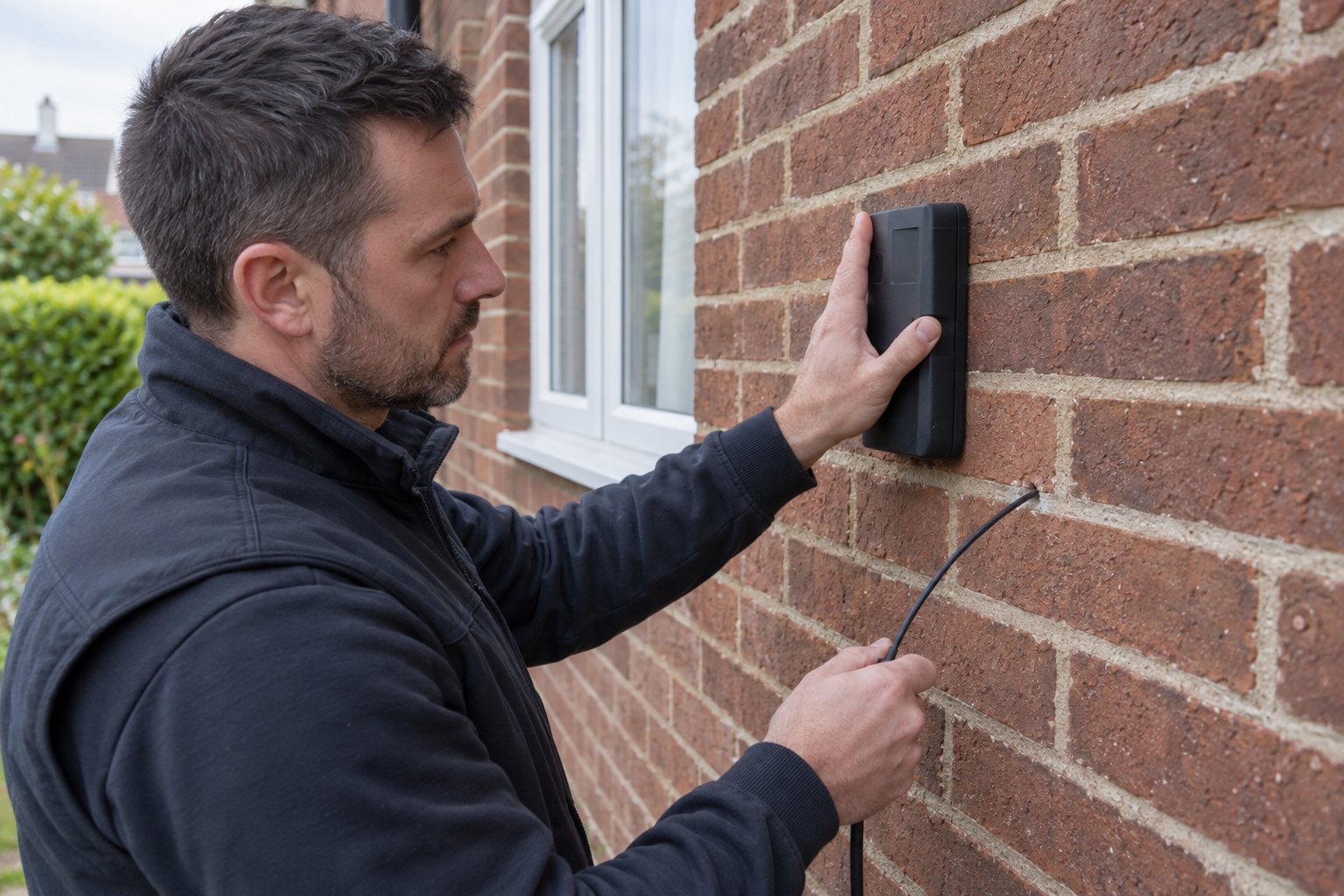
A properly scoped investigation moves beyond surface appearance. The exact procedure depends on the wall, finishes, insulation and access, but industry guidance includes the following stages.
Locating the ties
A metal detector can be used to scan the wall and identify likely tie positions. This helps estimate density and shows whether the observed crack pattern corresponds with courses containing ties. It may also reveal unexpectedly sparse or irregular placement.
Examining representative ties
A small drilled access point can allow a borescope or endoscope to inspect the cavity near a tie. The specialist records its apparent type, position, condition and surrounding debris. Cavity insulation can restrict the view.
An endoscope cannot always show the most vulnerable embedded end clearly. Where greater certainty is necessary and permission is obtained, selective opening-up may be recommended so that representative ties can be examined where they enter the inner or outer leaf. Different walls and heights should be sampled because conditions can vary across a building.
Reporting the findings
The report should describe the scope, locations investigated, access limitations, evidence found and whether the issue appears localised or widespread. If repair is needed, the recommendation should relate to the masonry, cavity width, wall height, exposure and nature of the defect — not simply quote a standard number of ties for every house.
How are failed wall ties repaired?
Cavity wall tie replacement commonly involves installing a designed pattern of remedial ties, often stainless steel, into sound areas of the inner and outer leaves. The tie and fixing method must suit the substrate. Site testing may be required to demonstrate adequate anchorage, and recognised guidance such as BRE Digests 329 and 401 informs specialist design and proof testing.
New ties do not always solve the disruptive effect of the old ones. Heavily corroded mild-steel ties can continue to expand, so a specification may include isolating, cropping or removing them where practicable. Associated work can include repointing, replacing damaged bricks, clearing local cavity debris and repairing render.
If the wall is substantially bowed or unstable, ties alone may be insufficient. Partial reconstruction or a bespoke structural solution could be required. A Structural Survey or advice from a residential structural engineer is appropriate where excessive deformation, unusual loading or wider structural issues are suspected.
How to assess a contractor’s proposal
Buyers and owners should compare scope, not just headline price. A useful proposal should make clear:
- which elevations and areas will be treated;
- what investigation supports the diagnosis;
- the proposed tie type, fixing method and pattern;
- how the system suits the existing brick, block, mortar and cavity;
- whether site tests will be carried out and recorded;
- how existing corroded ties will be dealt with;
- what masonry repairs and making good are included;
- responsibility for scaffolding, access and protection;
- the form, duration and transferability of any guarantee;
- whether independent structural design or Building Control input is needed.
A quotation that assumes every crack is tie failure may result in unnecessary work. Conversely, a cosmetic repointing allowance is inadequate if a proper investigation finds loss of restraint.
Before-exchange checklist for buyers
- ☐ Tell your surveyor if the viewing revealed horizontal cracks, bowing or previous drill-hole repairs.
- ☐ Commission the appropriate home survey rather than relying on a mortgage valuation.
- ☐ Ask the seller when cracking was first noticed and whether it has changed.
- ☐ Request all prior wall-tie reports, specifications, test results, invoices and guarantees.
- ☐ Check whether any guarantee transfers to a new owner and what it actually covers.
- ☐ Obtain a specialist investigation if the survey recommends one; do not base a repair budget on appearance alone.
- ☐ Ask for quotations that include access, testing, treatment of old ties, brickwork repairs and making good.
- ☐ Seek structural-engineer advice where the wall is substantially distorted or the cause remains uncertain.
- ☐ Ask your conveyancer to review approvals, guarantees and any implications for a shared or party structure.
- ☐ Keep a sensible contingency for concealed conditions and decide whether the evidence changes the price you are prepared to pay.
Does wall tie failure mean you should not buy?
Not automatically. Many diagnosed tie problems can be repaired using established methods. The decision depends on extent, wall condition, access, the quality of the proposed solution and whether significant distortion has already occurred.
A buyer should be cautious where the seller refuses recommended investigation, where previous work has no supporting records or where serious bowing is dismissed as a cosmetic crack. By contrast, a clear specialist report, properly scoped remedial works and reliable documentation can turn uncertainty into a manageable property decision.
Frequently asked questions
Can a chartered surveyor see wall ties?
Not normally during a standard visual survey because wall ties are concealed inside the cavity and embedded in mortar. The surveyor may identify warning signs and recommend further investigation. A specialist can use detection equipment, a borescope and, when justified and authorised, selective opening-up.
Are horizontal cracks always caused by wall tie failure?
No. A regular horizontal pattern can be characteristic of corrosion in some types of tie, especially where the wall is also distorted, but thermal movement, moisture, embedded metal and other construction defects can produce horizontal cracks. Diagnosis should consider the whole elevation and representative concealed ties.
Does an older house definitely need new wall ties?
No. BRE identified premature corrosion risk in some pre-1981 steel ties, but age is only one factor. Material, coating, exposure, damp, mortar and workmanship all influence tie condition. Investigation should be evidence-led.
Can wall tie corrosion make a wall unsafe?
Advanced loss of connection or severe deformation can affect stability, especially on an exposed elevation. That is different from saying every corroded tie creates an immediate danger. Loose masonry, pronounced bowing or rapidly changing cracks should receive prompt professional assessment.
How is cavity wall tie failure confirmed?
A specialist typically combines a visual defect survey with scanning to locate ties and an endoscopic inspection of representative positions. In some cases, the embedded end must be exposed to assess corrosion properly. The report should explain sampling and limitations.
Can new wall ties be installed while old ones remain?
Sometimes, but the old ties must not be ignored. If they are heavily corroded and continuing to expand, the repair specification may require them to be isolated, cropped or removed where practicable. The correct approach is site-specific.
Does cavity-wall insulation make the survey harder?
It can. Insulation may obscure the endoscope view, complicate access and affect moisture pathways. The specialist should record its presence and explain how it influenced the investigation and proposed work.
Will a wall-tie problem affect my mortgage or buildings insurance?
Policies differ. A lender or insurer may request a specialist report, evidence of repair or a structural opinion if there is significant cracking or distortion. Do not assume a universal outcome; provide the evidence requested and clarify the position before exchange.
Get the right level of investigation
The most valuable advice is often knowing when a visible crack is low risk and when concealed construction needs to be checked. Harding Chartered Surveyors provides independent Building Surveys, Specific Defect Reports and structural advice across London and the South East. We can assess the wider building, explain what the visible evidence does — and does not — show, and recommend proportionate next steps before you commit.
This article provides general information for UK homebuyers and is not a substitute for a property-specific inspection or specialist diagnosis.