

RICS Snagging Survey in London & South East
Independent new-build inspections and photographed snagging reports across London and the South East.
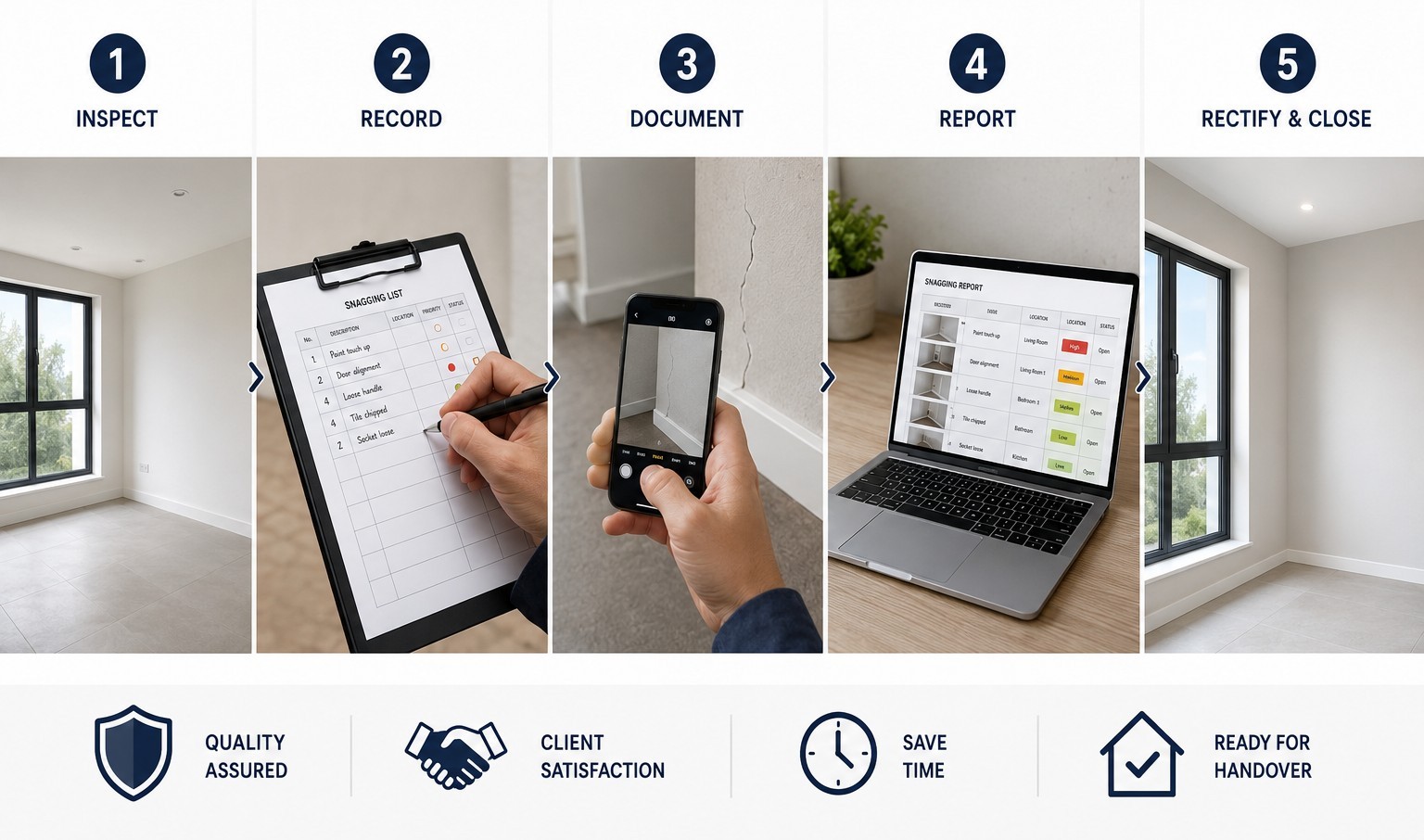
A professional snagging survey in London identifies defects, unfinished work and poor workmanship in a newly built home, either before or shortly after completion. The inspection covers visible internal and external elements — from decorative finishes and doors to plumbing, ventilation, insulation and drainage — with each issue recorded in a clear, photographed report you can give to your developer.
Harding Chartered Surveyors is an RICS-regulated firm providing independent snagging surveys across London and the South East. Obtain an instant quotation below, or use our room-by-room checklist further down the page to carry out your own initial inspection.
In short
- A snagging survey is an independent inspection of a new build that records defects and unfinished work in a clear, photographed report for your developer.
- It creates a documented record of items that may fall below the agreed specification or applicable standards — giving you a clear basis on which to ask the developer to put them right.
- Your position is strongest before legal completion. If your developer is registered under the New Homes Quality Code, you can appoint a suitably qualified inspector to carry out a pre-completion inspection on your behalf.
- Most snags are minor and cosmetic; the value of a survey is catching the functional and structural issues an untrained eye misses, and evidencing them properly.
- For developers registered under the Code, after-sales snags should be settled within 30 days in most cases, unless there is a significant reason for delay.
- Harding Chartered Surveyors carry out independent snagging surveys by RICS Chartered Surveyors across London & the South East — get an instant quote.
Reviewed by
David Toogood FRICS,
Chartered Surveyor at Harding Chartered Surveyors
Last reviewed 15

What Is a Snagging Survey?
A snag is a minor imperfection or fault that affects the expected quality or finish of a new home — a paint splash, a poorly hung door, uneven grouting. A snagging survey is an independent inspection carried out by a professional, such as an RICS Chartered Surveyor, who records each issue in a photographed report so your developer can put it right.
It helps to separate two types of issue:
- Cosmetic and finishing snags — paint splashes, scuffed skirting, uneven grouting, marks on glass, minor plaster imperfections. The majority of items found are of this type.
- Functional and potentially significant defects — doors and windows that don’t seal, leaking plumbing, faulty electrics, poor ventilation, uneven floors, cracking beyond normal shrinkage, or drainage that doesn’t run away. These matter most.
Although “snagging” is commonly used as a general term, serious structural, safety or performance problems are more accurately described as defects, and may require further investigation beyond a visual inspection.
New homes are checked by Building Control and by the housebuilder, but they are hand-built by many different trades, so things still get missed. A snagging survey gives you a documented, photographed record of items that may fall below the agreed specification or applicable standards — a clear basis on which to ask the developer to address them.
Snagging Survey Quote
Snagging surveys for London flats and new-build developments
A large share of London’s new homes are apartments in larger developments, which raises considerations a standard house snag won’t cover. When we inspect a London flat we look at the points specific to apartment living, and confirm with you in advance what is included:
- New-build apartments within high-rise and multi-storey developments
- Concierge or developer access arrangements for the inspection
- Balconies, private terraces and their drainage and balustrades
- Whether communal areas, corridors and shared spaces are within scope
- Mechanical ventilation and heat-recovery (MVHR) systems
- District or communal heating interfaces within the flat
- Limited access to roofs, façades and plant rooms
- Confirmation of what is demised to the individual flat
- Parking spaces, storage and cycle stores where included in the purchase
We carry out snagging surveys across London and the surrounding South East from our network of local offices. Contact us to confirm coverage for your development.
When should a snagging survey be carried out?
Timing matters, because your position is strongest before you legally complete and weakens once you have moved in.
Before completion: the pre-completion inspection
If your developer is registered with the New Homes Quality Board (NHQB), the New Homes Quality Code gives you the opportunity to carry out a pre-completion inspection before legal completion — either yourself, or through a suitably qualified inspector appointed on your behalf. Under the Code, a suitably qualified inspector must be a member of a recognised professional association experienced in residential surveying (such as RICS, RPSA, CABE, CIOB or ICWCI), hold relevant professional indemnity insurance, work within their competence, and carry out the inspection using the official NHQB Pre-Completion Inspection Checklist.
The pre-completion inspection process is not intended to delay or prevent completion. If a serious defect or safety concern is identified, speak to your conveyancer promptly about the appropriate next steps.
After completion: the first two years
Under most new home warranties, the developer remains responsible for putting right defects in the period after completion, and registered developers must provide an after-sales service for at least two years. A photographed snagging report gives you dated evidence to submit. For developers registered under the New Homes Quality Code, after-sales snags should be dealt with as soon as possible and, in most cases, within 30 days — unless there is a significant reason for delay, in which case the developer should explain it and provide regular updates.
Your warranty and the New Homes Ombudsman
Many new homes carry a ten-year warranty and insurance policy. Under NHBC Buildmark, this normally comprises a two-year builder warranty followed by eight years of insurance cover for defined damage caused by defects in specified parts of the property, subject to the policy conditions. Other providers, such as LABC Warranty and Premier Guarantee, offer similar structures. If a registered developer doesn’t resolve an issue, the New Homes Ombudsman Service can adjudicate.
The most common new-build defects
Snags are near-universal in new builds — most buyers report at least some. The Home Builders Federation’s 2026 customer satisfaction survey reported that 90% of respondents were satisfied with the quality of their home, and one in five said they encountered fewer snags than expected; most, however, still reported some issues to their builder, the vast majority of them minor. The point of a survey is to make sure those issues are found and documented so they actually get fixed. The defects we see most often include:
- Cracking to plaster and decorative finishes
- Poorly fitted or unsealed doors, windows and frames
- Unfinished joinery, tiling, grouting and sealant
- Uneven or squeaking floors, stairs and skirting gaps
- Plumbing leaks, weak water pressure and slow drainage
- Faulty electrics, unlabelled circuits and non-working extractors
- Inadequate loft insulation and ventilation
How much does a snagging survey cost?
Our professional snagging surveys start from £750, with the final fee depending on the type, size, value and location of the property. Set against a new-home defect that could cost thousands to put right once your leverage has gone, a snagging survey is a small, sensible investment.
Your quotation includes the full photographed report, and we’ll confirm the expected turnaround when you book. If you’d like a return inspection after remedial works, or have communal areas to include, let us know and we’ll factor that in. Use our instant quote tool for a firm price on your property.
Snagging List Example Report
If you would like to see a snagging list example report, please click here to download our example report.
Professional snagging survey versus DIY
You can use the checklist further down this page to snag your own home, and for a straightforward flat with mostly cosmetic issues that may be enough. A professional survey is worth it when you want certainty that nothing has been missed — particularly the functional and structural items an untrained eye overlooks.
An independent RICS Chartered Surveyor brings three things you can’t replicate yourself:
- Expertise — knowing what falls below standard against warranty technical and Building Regulations requirements, not just what looks wrong.
- Impartiality — working for you, not the developer that built the property.
- Evidence that carries weight — an independent, clearly structured report that supports your discussions with the developer.
Why choose an RICS Chartered Surveyor for your snagging list?
Harding Chartered Surveyors is RICS-regulated and we’ve produced snagging lists and survey reports across London and the Home Counties for over 30 years, and our work is rated “Excellent” by clients on Google and Trustpilot. When you instruct us for a snagging survey you get a thorough, independent inspection and a clear, photographed report you can hand straight to your developer.
If you’re still deciding what level of inspection you need, see our guide to which survey is right for you, or compare our Building Survey and Homebuyer Report for older or non-new-build properties.
Recent Reviews from Harding Chartered Surveyors
















Free new build snagging checklist (room by room)
Important: this room-by-room checklist is a general guide for your own initial inspection. Where the New Homes Quality Code applies to a formal pre-completion inspection, the official NHQB Pre-Completion Inspection Checklist must be used.
Work methodically: outside first, then inside, room by room, top to bottom. Take a tape measure, a spirit level, a torch, a phone charger and your phone for time-stamped photos. Describe each snag precisely — the exact issue and its location, e.g. “3cm scratch, lower-left pane, living room window.”
Outside & exterior
Roof & chimney — tiles straight, none cracked, slipped or missing; ridge tiles secure; flashing neat around chimneys and abutments.
Brickwork & render — consistent colour, no cracks, chips or gaps in the mortar; pointing even; render smooth and unmarked.
Gutters, fascias & downpipes — securely fixed, aligned, free of debris and clearly draining into the drainage system.
Doors & windows (externally) — frames sealed, no gaps, even reveals, trickle vents fitted, glazing free of scratches and condensation between panes.
Drainage & manholes — gullies clear, covers seated correctly, water draining away from the property.
Driveway, paths & patios — surfaces even with no trip hazards or standing water; falls run away from the house.
Garden, fences, gates & garage — boundaries complete and secure; gates and garage doors open, close and lock correctly; outside taps and lighting working.
External meters & service connections — gas, electricity and water meters accessible and correctly housed.
Hallway, stairs & landing
Each stair the same height and depth; treads firm; handrails and balustrades secure and at the correct height.
Walls and ceilings free of cracks and roller marks; lines, junctions and finishes appear straight and consistent.
Front door opens, closes and locks smoothly; weather seal intact; spy hole and chain (if fitted) working.
Light switches, sockets and the consumer unit (fuse board) labelled and functioning.
Smoke and heat alarms fitted; test following the manufacturer’s procedure (this is a function check, not certification).
Living & reception rooms
Walls, ceilings and coving free of cracks and finished evenly; lines and junctions straight and consistent.
Floors level and free of squeaks, lifting or hollow spots; skirting and architrave neat with no large gaps.
Sockets tested with a charger or socket tester — this confirms power is present, not an electrical safety test; TV, data and aerial points working.
Windows open, close, lock and seal; handles aligned; sills unmarked.
Radiators secure, level, heating evenly and free of leaks; thermostat responsive.
Doors hung correctly with consistent gaps to the frame; handles and latches working.
Kitchen & utility
Units level, doors and drawers aligned and closing properly; handles secure; worktops sealed at joints and against the wall.
Sink and taps run hot and cold, drain freely with no leaks under the unit; sealant neat.
Integrated appliances installed, level and working — oven, hob, extractor, fridge, dishwasher, washing machine; check seals and that manuals are supplied.
Tiling and splashbacks even, fully grouted and sealed; no cracked or lipped tiles.
Extractor vents to the outside; socket numbers and positions match the agreed specification.
Flooring laid flat with neat edges and thresholds.
Bathrooms & en-suites
Bath, basin, shower and WC secure, level and free of chips or scratches; toilet flushes and refills correctly.
Taps and showers run hot and cold with good pressure; no leaks; waste drains freely.
Sealant around baths, basins and shower trays continuous and neat; tiling even and fully grouted.
Extractor fan working and vented externally — essential for damp and mould control.
Heated towel rail / radiator working; shaver socket and lighting functioning.
Floor falls correctly to any drain; no movement underfoot.
Bedrooms
Walls, ceilings and finishes even; no cracks, nail pops or roller marks.
Windows operate, lock and seal; safety restrictors fitted where required upstairs.
Built-in wardrobes (if any) level, with aligned doors and working fittings.
Sockets, switches and light fittings tested; TV/data points working.
Doors hung evenly; carpet or flooring laid flat to neat edges.
Loft, services & whole-home checks
Loft insulation even and to the specified depth, where safely accessible and measurable against the specification; loft hatch fitted.
No unintended daylight visible through roof coverings (excluding designed ventilation openings).
Boiler and hot water system working; heating reaches every room; controls and timer operating.
Water pressure consistent across taps; stopcock accessible and labelled.
Ventilation (MVHR or background vents) installed and running where specified.
Internal doors, handles and ironmongery consistent throughout; keys provided for all locks and windows.
All instruction manuals, warranties, certificates and the home demonstration paperwork handed over.
Snagging list FAQs
What does a snagging survey include?
An independent inspection of the visible and accessible elements of your new build — finishes, doors and windows, kitchens and bathrooms, visible plumbing and electrics, heating and ventilation, floors, loft and external elements — with each issue recorded in a photographed report for your developer.
How long does a snagging survey take?
It depends on the size and type of property, but most homes take a few hours to inspect thoroughly. We’ll give you an indication when you book.
How soon will I receive the report?
We’ll confirm the expected turnaround at the time of booking so you have your photographed report in good time to raise items with your developer.
Is a snagging survey the same as an RICS Home Survey?
No. An RICS Home Survey (Levels 1–3) assesses the condition of a property — usually an existing home — for a buyer. A snagging survey is a defects-and-finish inspection of a new build, focused on items the developer should put right.
Can you inspect a new-build flat before completion?
Yes, subject to the developer’s access arrangements. Where your developer is registered under the New Homes Quality Code, you can appoint a suitably qualified inspector to carry out a pre-completion inspection on your behalf.
Are communal areas included in a snagging survey?
Communal corridors, shared spaces and external areas can be included by arrangement. Tell us what you’d like covered and we’ll confirm scope and any access requirements in your quote.
Can a snagging survey identify structural defects?
A visual snagging survey can flag visible signs of a potential problem, but it cannot confirm concealed construction or provide invasive investigation unless that is specifically agreed. Where a serious defect is suspected, we’ll advise on the appropriate further investigation.
Can the developer refuse access before completion?
Developers registered under the New Homes Quality Code must give you the opportunity for a pre-completion inspection, subject to health-and-safety arrangements on an active site. If you encounter difficulty, speak to your conveyancer.
Do I need a second inspection after the repairs?
Many buyers choose a return inspection to confirm the developer has properly completed the remedial works. Let us know and we’ll include it in your quote.
Do you carry out snagging surveys near me?
We cover London and the South East from offices across the capital and the Home Counties. Contact us to check coverage for your development.
Ready to protect your investment? Get an independent snagging survey from an RICS-regulated firm covering London and the South East. Get your free, no-obligation instant quote or call our chartered surveyors today.