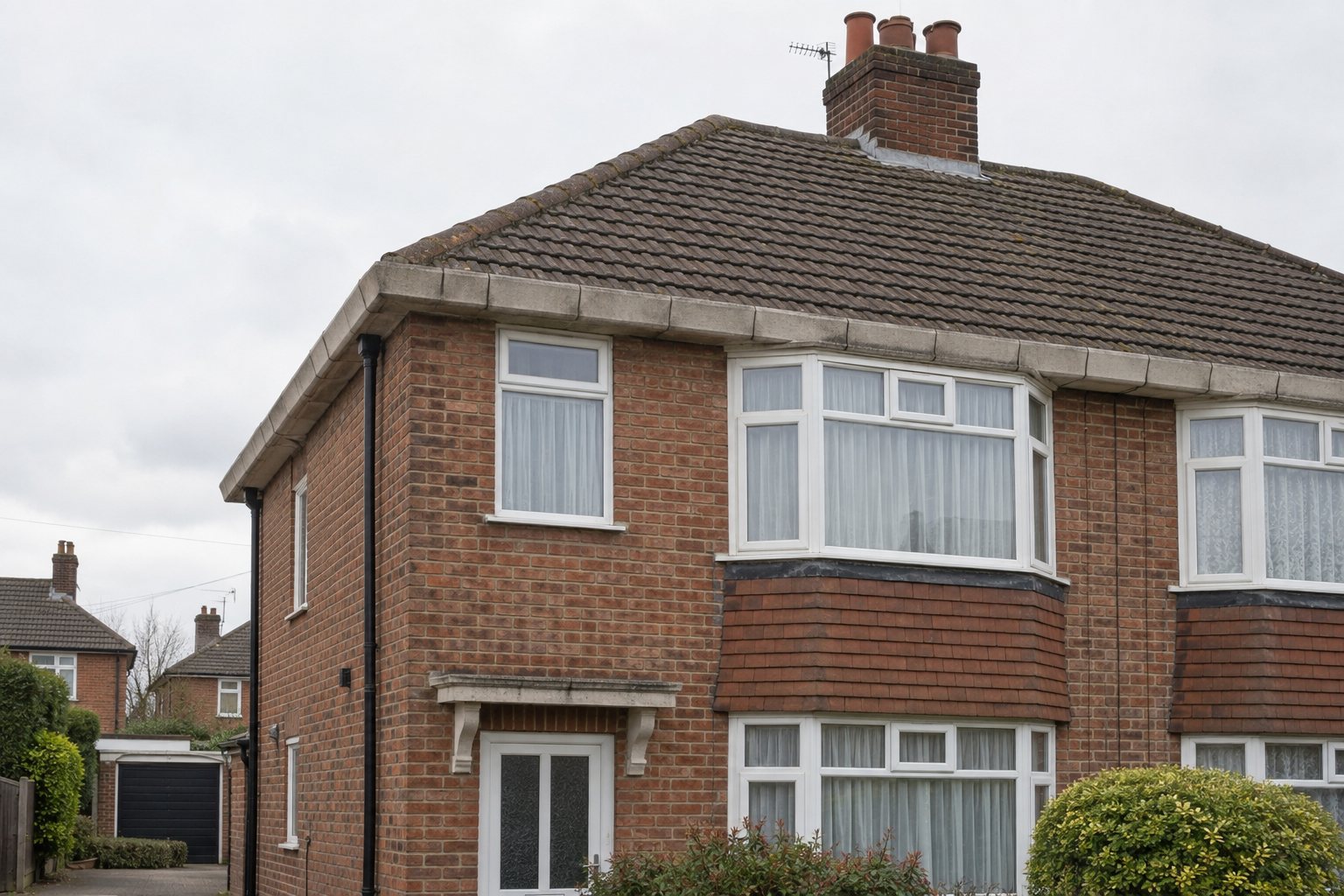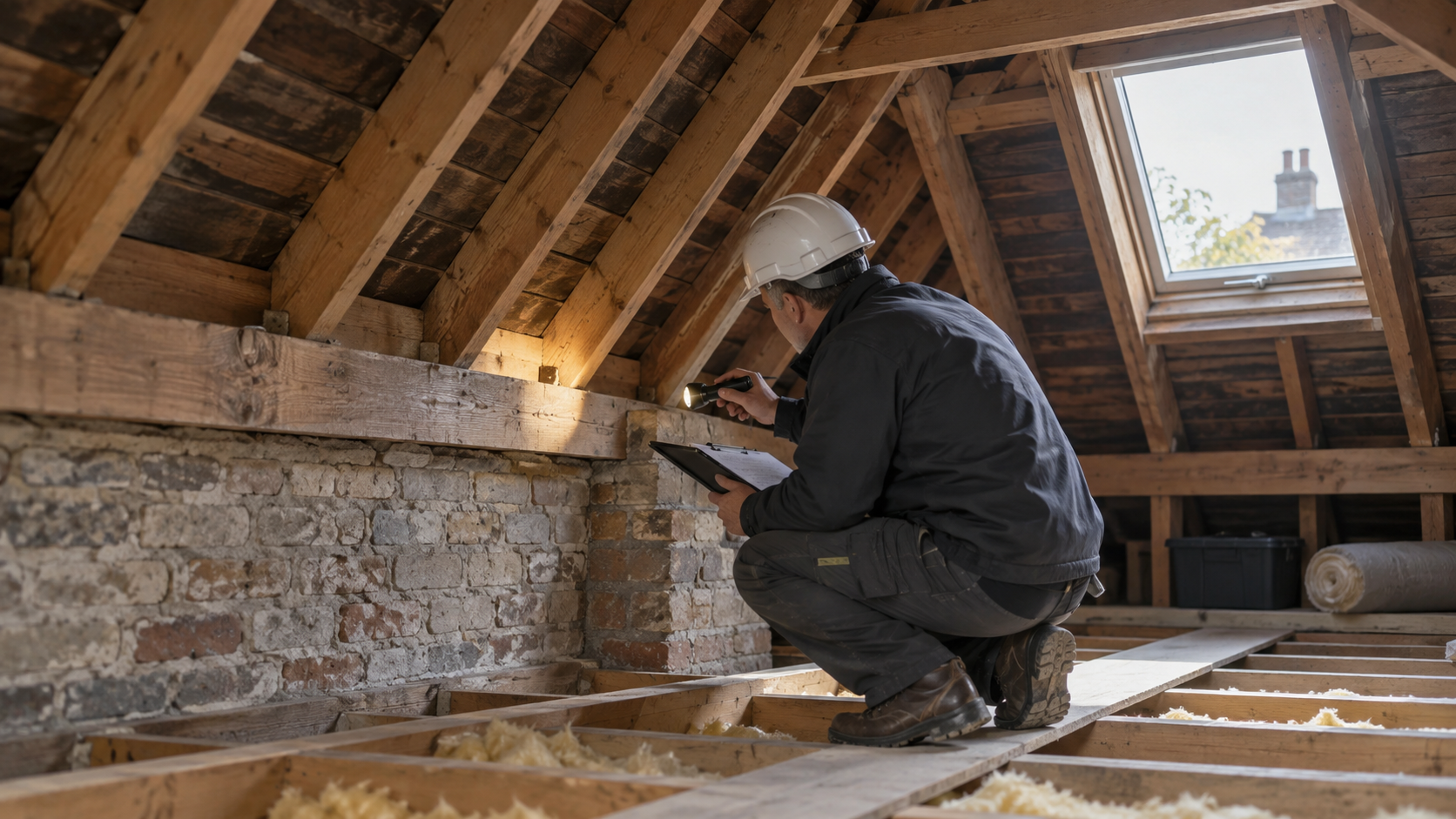

If a house survey mentions suspected asbestos, do not panic and do not disturb the material. The wording usually means that the surveyor saw a product, in a property of an age, that could contain asbestos; it does not mean asbestos has been confirmed. A normal RICS home survey is a visual inspection, not a specialist asbestos survey. Before exchange, ask what prompted the warning, collect any existing records and, if the answer could affect your purchase or renovation plans, arrange the appropriate specialist investigation with the seller’s permission.
In short
- A surveyor may recognise a material that could contain asbestos, but cannot confirm its fibre content by sight.
- Buildings built or refurbished before 2000 may contain asbestos-containing materials.
- Do not drill, scrape, sand, break or take your own sample from a suspect product.
- Where no reliable existing analysis is available and confirmation is needed, representative sampling by a competent person and analysis by a UKAS-accredited laboratory are normally required.
- Asbestos in good condition and unlikely to be disturbed does not always require removal.
- Obtain the evidence and likely costs before exchange if the issue could change your decision.
What does “suspected asbestos” in a survey report mean?
Surveyors use careful language for a reason. Products containing asbestos can look much like non-asbestos alternatives, and different versions of the same building product may have been manufactured with or without it. The age, appearance and location of a material may justify suspicion, but they do not provide laboratory confirmation.
The report may refer to a specific item, such as textured ceiling coating, old floor tiles, a garage roof or soffit boards. It may instead contain a general warning because the property was built or altered during a period when asbestos was commonly used. Those are not the same finding, so the first useful step is to ask the surveyor:
- Which material or location caused the concern?
- Was the comment based on a visible item or the age of the property alone?
- Did the material appear damaged, weathered or vulnerable to disturbance?
- Is further investigation recommended before exchange, or mainly before future building work?
That conversation helps distinguish a routine precaution from an issue that needs prompt specialist attention.
Can an RICS house survey confirm asbestos?
No. An RICS Home Survey is designed to assess the visible and accessible condition of a property. It is not an asbestos inspection and does not include laboratory analysis. The terms for an RICS Level 2 Home Survey expressly state that the surveyor does not act as an asbestos inspector, although suspected asbestos-containing materials should be highlighted where the inspection identifies the possibility.
A Level 3 Building Survey is more detailed than a Level 2 survey and is often the sensible choice for an older, altered or visibly defective property. Even so, it remains principally a non-destructive building inspection. The surveyor will not normally cut into walls, lift fitted floor coverings, dismantle boxing or take samples without separate instructions, permission and appropriate competence.
This distinction matters when buying a house. A chartered surveyor can:
- note products and locations commonly associated with asbestos;
- comment on their visible condition and accessibility;
- explain how the finding may affect maintenance or proposed alterations; and
- recommend an appropriate further investigation.
The surveyor cannot identify invisible fibres or rule out concealed materials throughout the building. A Level 3 report is not converted into an asbestos survey simply because it is the most comprehensive RICS home survey.
Where might asbestos be present in a home?
The Health and Safety Executive advises that asbestos may be present in any domestic or commercial building built or refurbished before 2000. That date is a useful screening point, not proof that a particular house contains asbestos.
Potential locations include:
- textured decorative coatings on ceilings and walls;
- asbestos insulating board around boilers, fires, service cupboards or partition walls;
- pipe and boiler lagging;
- vinyl floor tiles, backing paper and some bitumen adhesive;
- cement roof sheets, tiles, flues, gutters and downpipes;
- soffits, fascias and external panels;
- garage and shed roofs;
- water tanks and some older toilet cisterns; and
- loose-fill material in cavities or roof spaces.
Some of these products are relatively robust when intact; others are more friable and can release asbestos fibres more readily if damaged. Colour or texture is not a reliable test. Never use an online photograph as the basis for drilling, removing or sampling a suspect material.
Is asbestos always dangerous?
Asbestos is hazardous when fibres are released into the air and inhaled. The practical risk therefore depends on more than whether asbestos is present. Important factors include the type of product, its condition, whether it is sealed or exposed, its location and the likelihood that normal use or future work will disturb it.
An asbestos-containing cement sheet that is intact and out of reach presents a different management question from damaged insulation board beside frequently accessed services. HSE guidance says that material in good condition and unlikely to be disturbed may often be left in place and monitored. Removal is not automatically the safest or most proportionate answer, because poorly planned work can itself cause disturbance.
If the material is damaged, shedding debris or in an area where it could be struck, drilled or cut, keep people away and seek specialist health and safety advice. Do not vacuum, sweep or attempt a temporary DIY repair.
What should you do before exchange?

The correct response depends on the evidence, your plans and how much uncertainty you are willing to accept. The following table provides a practical starting point.
| Survey wording or situation | Sensible next step | Why it matters |
|---|---|---|
| General age-related warning with no particular material identified | Ask the surveyor whether a specific concern was seen | Avoids treating a standard precaution as a confirmed defect |
| One accessible suspect product is identified | Discuss targeted sampling with a competent specialist | Laboratory analysis may answer a focused question without surveying the whole property |
| Several suspect materials are visible | Ask a specialist asbestos surveyor to advise on the appropriate type of survey | A wider inspection may be more useful than isolated samples |
| Material appears damaged or vulnerable | Seek prompt specialist advice and prevent disturbance | Condition and likelihood of fibre release are central to risk |
| You plan major refurbishment | Commission a project-specific investigation before work begins | Hidden ACMs may be disturbed when the building fabric is opened |
| You are buying a leasehold flat | Request common-parts asbestos records through your conveyancer | Responsibility and future cost may sit with the freeholder or management company |
Before-exchange checklist
- ☐ Read the exact wording and condition rating in the survey report.
- ☐ Ask the surveyor which material and location prompted the comment.
- ☐ Ask the seller for previous asbestos surveys, laboratory certificates, removal records and guarantees.
- ☐ Check whether your planned works would disturb the suspect area.
- ☐ Obtain the seller’s written agreement for any sampling or intrusive inspection.
- ☐ Use a competent asbestos professional; do not take a DIY sample.
- ☐ Obtain a written scope, findings and recommendations rather than relying on a verbal opinion.
- ☐ Request quotations if encapsulation, management or asbestos removal may be required.
- ☐ Give relevant information to your conveyancer and, where appropriate, your lender and insurer.
- ☐ Make your decision before exchange, when you still have the opportunity to investigate or renegotiate.
What type of specialist asbestos survey might be needed?
There is no single investigation that suits every purchase. The right type of survey depends on the question you need answered.
Targeted sampling
Sampling can be appropriate where there are only one or two clearly identified suspect materials. A suitably trained person takes a small, representative sample under controlled conditions and sends it for analysis. Sampling answers whether that sample contains asbestos; it does not inspect the whole house or identify every concealed ACM.
Where no reliable existing analysis is available and confirmation is needed, representative sampling by a competent person and analysis by a UKAS-accredited laboratory are normally required. Asking the seller or estate agent to break off a piece is not a safe substitute.
Management survey
A management survey seeks, as far as reasonably practicable, to locate asbestos-containing materials that could be disturbed during normal occupation or foreseeable maintenance, and may involve minor intrusive investigation. It is more extensive than a normal building survey, but it is not designed to uncover every product concealed inside the fabric of a building. Its scope and access limitations should be made clear.
Refurbishment and demolition survey
If you intend to strip out a kitchen, remove ceilings, alter partitions, replace a roof or carry out other work that opens the building fabric, the investigation needs to match that project. A refurbishment and demolition survey is fully intrusive within the defined work area and may involve destructive inspection. It requires the owner’s permission, appropriate controls and careful planning before work begins.
The Control of Asbestos Regulations 2012 apply to work activities involving asbestos and place duties on employers and contractors. The statutory duty to manage also applies to non-domestic premises and the common parts of domestic buildings, but it does not apply to the private rooms of an ordinary owner-occupied house in exactly the same way. A homeowner should nevertheless give contractors all available asbestos information before work starts, and contractors must assess and control the risks arising from their work.
Does asbestos have to be removed before you buy?
Not necessarily. A specialist risk assessment may recommend leaving sound material undisturbed, recording its location and checking its condition. Other options can include sealing or enclosing it. Material that is badly damaged, likely to be disturbed or incompatible with proposed work may need removal by an appropriately trained contractor; certain higher-risk work requires an HSE-licensed contractor.
The seller is not automatically obliged to remove every ACM simply because it has been identified. Who pays, whether work happens before completion and whether the agreed price changes are matters for negotiation and legal advice. Obtain a clear specification and comparable quotations before agreeing a reduction: the cheapest headline removal figure may omit access, reinstatement, disposal or clearance requirements.
Keep any specialist survey, analysis certificate, method statement, waste documentation and clearance information. Good records can help contractors avoid accidental disturbance and may answer questions when the property is eventually sold.
Buying a flat with suspected asbestos
Leasehold purchases need an additional layer of enquiry. The inside of the flat may contain suspect materials, while the roof, corridors, risers, plant rooms and other shared areas are normally controlled by the freeholder or managing agent.
Ask your conveyancer to request any asbestos register and management plan relating to the common parts, along with information about planned remedial works and service-charge contributions. Check the areas actually covered by the records: a common-parts register should not be assumed to include finishes inside the flat.
This is also an occasion to read the lease. Responsibility for windows, balcony panels, service ducts or soffits varies between developments. A specialist finding is more useful when it is considered alongside the legal responsibility for managing and paying for the relevant element.
Should you still buy a house with asbestos?
Many UK homes contain or may contain asbestos, and its presence does not automatically make a purchase unwise. The decision becomes clearer when you replace a broad fear with specific questions:
- What material is involved, and has it been confirmed?
- Is it intact or deteriorating?
- Can it be left undisturbed during normal occupation?
- Will your refurbishment plans affect it?
- What management, removal and reinstatement work is recommended?
- What are the documented costs and responsibilities?
- Has your lender, insurer or conveyancer raised a particular requirement?
A manageable, intact product may have little effect on day-to-day occupation. Extensive damaged material, or ACMs throughout a property you intend to remodel, may have significant cost and programme implications. Neither scenario should be assumed without evidence.
Frequently asked questions
Does a Level 3 Building Survey test for asbestos?
No. A Level 3 survey is a detailed assessment of the property’s visible and accessible construction and condition, but it is not a specialist asbestos inspection or laboratory test. It may flag suspect materials and recommend further investigation.
Should I withdraw if my survey mentions asbestos?
Not on that wording alone. Find out whether the comment is a general precaution or relates to a particular damaged material. Obtain specialist evidence where it could materially affect your decision, then consider condition, proposed works, cost and professional advice.
Can asbestos be identified by looking at it?
Visual appearance can create a reasonable suspicion, but confirmation requires representative sampling and analysis. Similar-looking products may have different compositions.
Is asbestos safe if it is not disturbed?
An ACM that is sealed, in sound condition and unlikely to be disturbed may often be managed in place. Its condition and location should be recorded and monitored. Damaged or vulnerable materials need specialist assessment.
Can I take an asbestos sample myself?
You should not. Sampling can release fibres and may produce an unrepresentative result. Use a competent person and suitable accredited laboratory arrangements.
Does a seller have to remove asbestos?
There is no blanket rule requiring a residential seller to remove every asbestos-containing product. Disclosure, contractual responsibility and any price adjustment should be discussed with your conveyancer. Never rely on an informal promise that material will be “made safe”.
Can asbestos affect a mortgage?
It can affect a lender’s decision where condition, value or necessary work is material, but there is no universal outcome. Provide any requested specialist report and quotation to the lender rather than assuming the property is unmortgageable.
Do I need an asbestos survey before renovating?
If work will disturb materials in a building built or refurbished before 2000, suitable information is needed before the work begins. A specialist should define whether targeted sampling or a project-specific refurbishment and demolition survey is appropriate.
Clear advice before you commit
Harding Chartered Surveyors can inspect the visible condition of a property, explain the significance of suspected materials within the scope of an RICS home survey and advise when specialist investigation should be obtained. Harding does not confirm asbestos through appearance alone, and specialist sampling and laboratory analysis must be separately arranged where certainty is required.
If you are buying an older or altered property, compare our Level 2 and Level 3 property surveys or contact Harding Chartered Surveyors to discuss the appropriate level of inspection before exchange.
This article provides general information for UK homebuyers and is not a substitute for a property-specific inspection or specialist diagnosis.