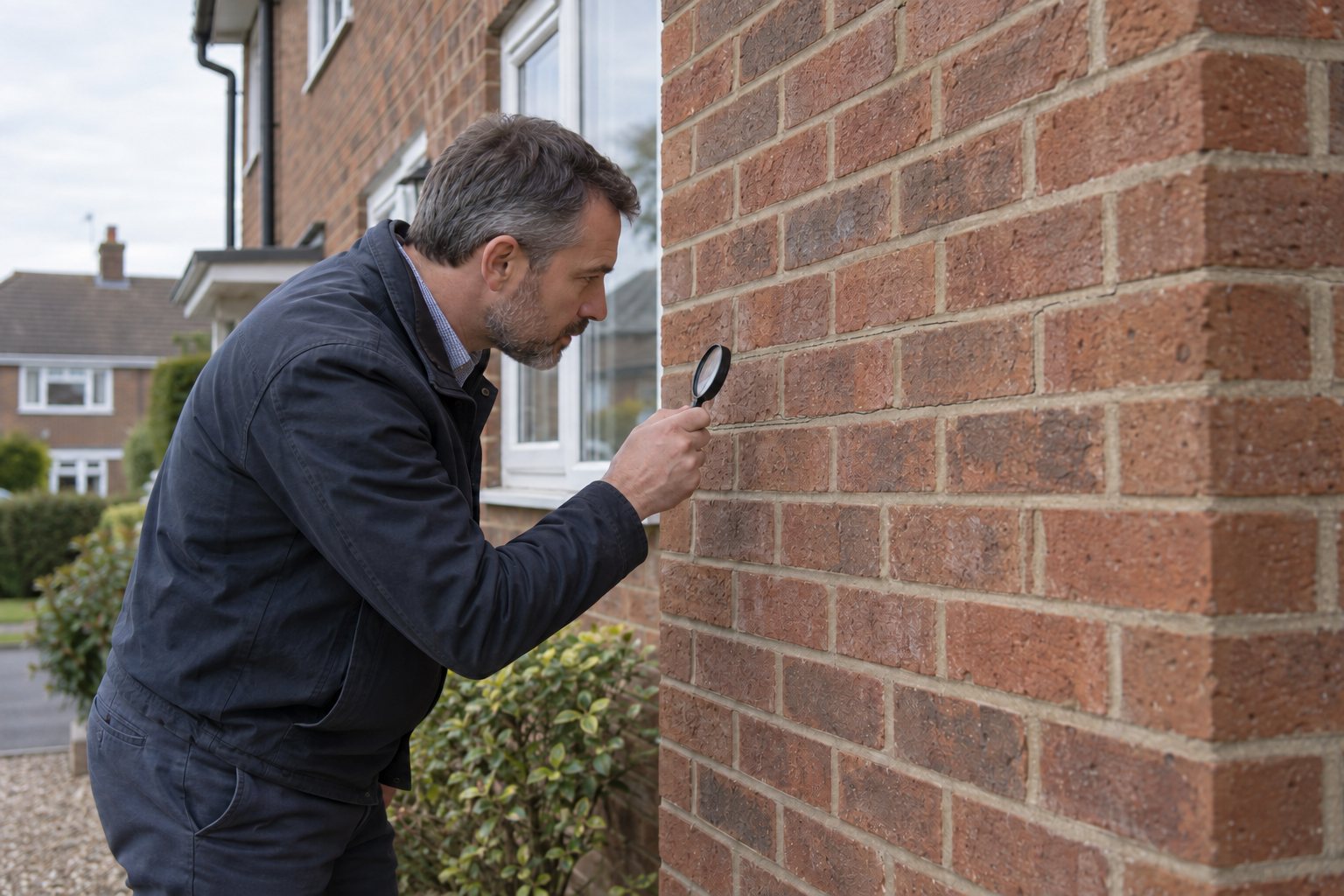

Finding the words “possible pitch fibre drains” in a home survey can be unsettling, but it is not an automatic reason to abandon a purchase. It means there is a known risk that cannot usually be resolved by a visual inspection alone. A specialist CCTV drain survey can establish the pipe material and condition, helping you make a decision based on evidence before you exchange contracts.
In short
Pitch fibre drainage was widely installed in post-war properties, mainly between the 1950s and 1970s. The material can deform, blister or delaminate as it ages, but not every pitch fibre drain has failed. A Level 2 or Level 3 home survey may reveal clues and accessible parts of the system; it does not normally include a camera inspection of the underground runs. Where pitch fibre is identified or reasonably suspected—particularly if there are drainage problems, restricted access or signs of ground movement—a surveyor may advise a specialist CCTV investigation before exchange.
What are pitch fibre drains?
Pitch fibre pipes were promoted as a modern alternative to heavier vitrified clay pipes. They were made from wood or cellulose fibre impregnated with coal tar pitch, producing lengths that were light, inexpensive and relatively quick to install. They became particularly common during the post-war building boom, although the precise material used at an individual property cannot be established from its age alone.
The often-quoted life expectancy for correctly installed pitch fibre pipe is around 40 years. That is a broad design estimate rather than an expiry date. Installation quality, ground conditions, loading, the substances passing through the drain and previous repairs can all affect lifespan. Some pipes remain serviceable beyond that period; others suffer significant deterioration much earlier.
This distinction matters to a buyer. The presence of pitch fibre indicates a risk worth investigating, but its current condition is more useful than a conclusion based only on age.
Why can a pitch fibre pipe deteriorate?
Unlike rigid clay pipes, pitch fibre pipework can gradually lose its shape or internal integrity. Common forms of deterioration include:
- Delamination: layers on the inside of the pipe separate, reducing the clear opening and trapping waste.
- Blister formation: the internal surface can blister or bubble, disrupting flow through the drain.
- Deformation: ground pressure or loading can turn a circular pipe into a flattened or oval shape.
- Joint and connection defects: movement or ageing at connections may allow leakage or root entry.
- Restricted flow and blockage: deformation, debris, roots or loose internal material can reduce capacity.
- Collapse: in a severely weakened section, the pipe can lose structural integrity and cease to function.
Hot water, fats and oils have also been associated with softening of the coal-tar material. However, a slow sink or a single blockage does not prove that pitch fibre is present or failing. Drainage problems can arise from many causes, including poor falls, displaced clay joints, roots, foreign objects and damaged modern pipework.
A safety point about historic pipework
Some historic water and sewage pipe products incorporated asbestos reinforcement. For repair planning, pitch fibre should be treated as potentially asbestos-containing unless competent assessment or analysis establishes otherwise. It must not be cut, broken or otherwise disturbed without an appropriate risk assessment and controls.
Can a chartered surveyor identify pitch fibre drains?
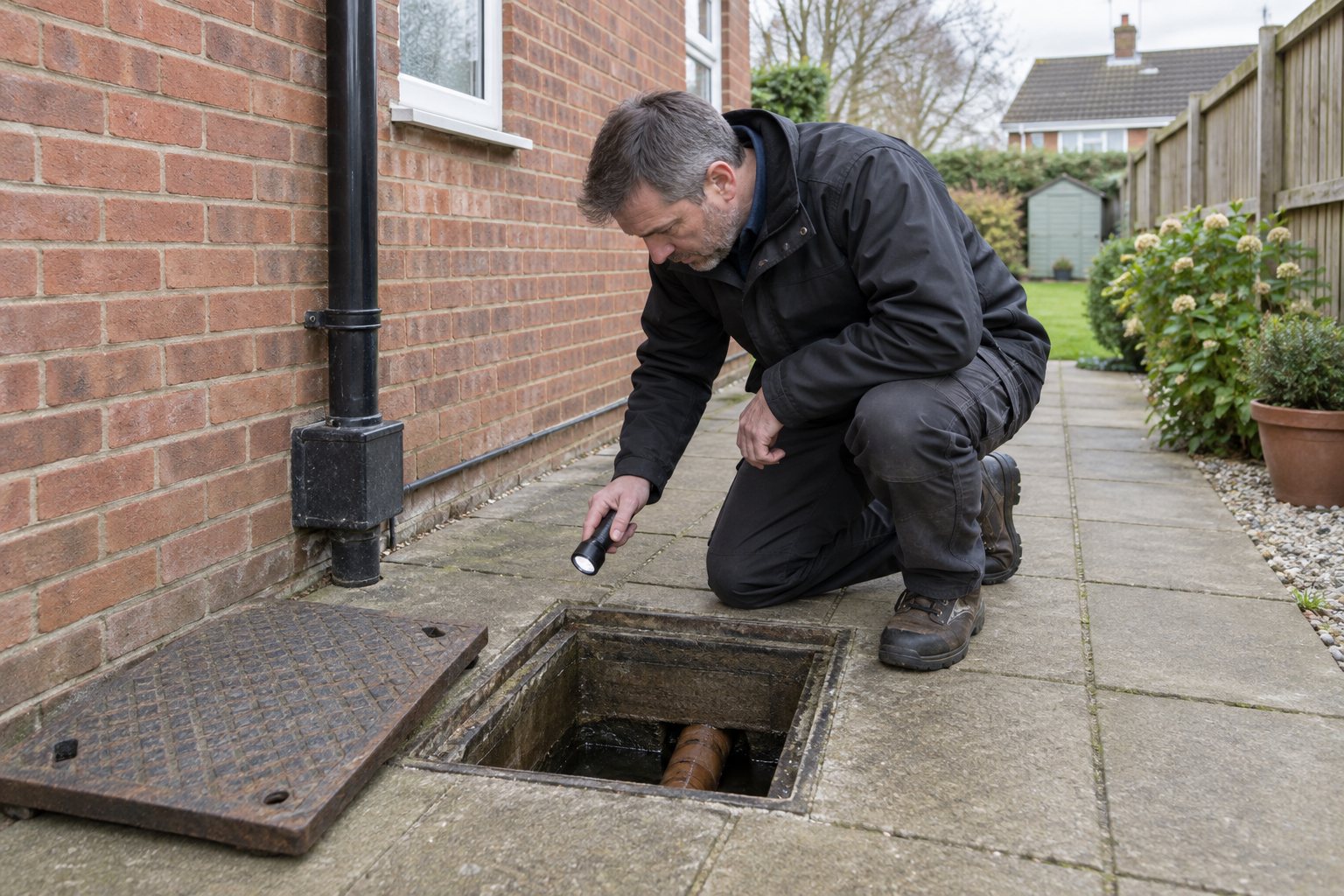
Sometimes, but not always. When an inspection chamber is safely accessible, the surveyor may see a dark, fibrous-looking pipe or remnants of black pitch at a connection. The age of the property and knowledge of drainage used on the surrounding estate may also raise reasonable suspicion.
Identification is not always straightforward. A pitch fibre pipe may connect to a vitrified clay channel as it enters an inspection chamber. Looking down at a clay channel therefore does not prove that the concealed run is also clay. Covers may be locked, rusted, buried beneath landscaping or too heavy to lift safely. Some properties have no accessible chamber within the boundary at all.
A surveyor should report what was visible, explain any limitations and consider the wider evidence. They may also take account of:
- standing water, deposits or poor flow visible in a chamber;
- recurring blockages or repairs disclosed by the seller;
- unpleasant smells, gurgling or slow discharge;
- mature trees close to the likely drain route;
- an extension built over or close to underground drainage;
- cracking, local settlement or ground movement near the suspected route; and
- missing information about the layout, material or ownership of the system.
None of these clues is conclusive in isolation. Their importance lies in whether they create a sensible trail for further investigation.
What does a Level 2 or Level 3 survey check?
There is a crucial difference between inspecting visible drainage features and surveying the inside of buried pipes. Both the RICS Level 2 Homebuyers Survey and the more detailed RICS Level 3 Building Survey are principally visual inspections. Neither automatically includes specialist CCTV equipment.
| Type of inspection | What normally happens | Important limitation |
|---|---|---|
| RICS Level 2 Home Survey | Accessible inspection-chamber covers are lifted where it is safe and possible without causing damage, and the chamber is visually inspected. Visible parts of services are considered. | The surveyor does not test the service installation, remove secured covers or inspect the full internal length of concealed pipes. CCTV is not normally included. |
| RICS Level 3 Building Survey | Accessible chambers are inspected and the normal operation of drains may be observed in everyday use where practicable and safe. The wider property and potential consequences of defects receive more detailed consideration. | Services are still not technically tested. Hidden runs remain concealed, and a camera survey is not included unless separately agreed. |
| Specialist CCTV drainage survey | A drainage contractor introduces a camera through a suitable chamber, rodding eye or other access point to record the inside of accessible runs. | The result depends on access, cleanliness and whether the camera can pass obstructions or collapsed sections. It does not replace the building survey or legal ownership checks. |
Even a Level 3 inspection is not an excavation, pressure test or guarantee covering every metre of pipe. Its value is in identifying material risks, explaining their significance and advising when a separate specialist is needed. Harding’s Level 2 versus Level 3 comparison explains the broader differences between the two survey levels.
When might a surveyor recommend a CCTV drain survey?
A recommendation should be based on the property and evidence, rather than added automatically to every report. A CCTV survey is particularly reasonable where:
- Pitch fibre is visible or reasonably suspected. Its concealed condition cannot be judged reliably from one exposed connection.
- The drainage inspection was materially restricted. A secured or inaccessible chamber can leave the material, route and condition unknown.
- There are symptoms of a recurring problem. Repeated blockage, backing-up, slow flow, odours or previous drain repairs warrant explanation.
- The accessible chamber contains warning signs. Standing water, roots, deposits, displaced connections or an apparently deformed pipe may justify a closer look.
- There is relevant cracking or ground movement. A leaking drain can sometimes soften or wash out supporting ground, although cracking has many possible causes. Where movement is the main concern, a specialist subsidence survey may also be appropriate.
- An extension or heavy structure affects the likely route. The buyer needs to understand both pipe condition and the practical implications of access for future work.
- The result could materially affect the purchase. If a significant concealed defect might change the offer, insurance position or decision to proceed, obtaining evidence before exchange is usually preferable to guessing afterwards.
Property age can support the recommendation, but age alone should not be treated as proof that the drainage system is pitch fibre or defective.
What does a CCTV drain survey reveal?
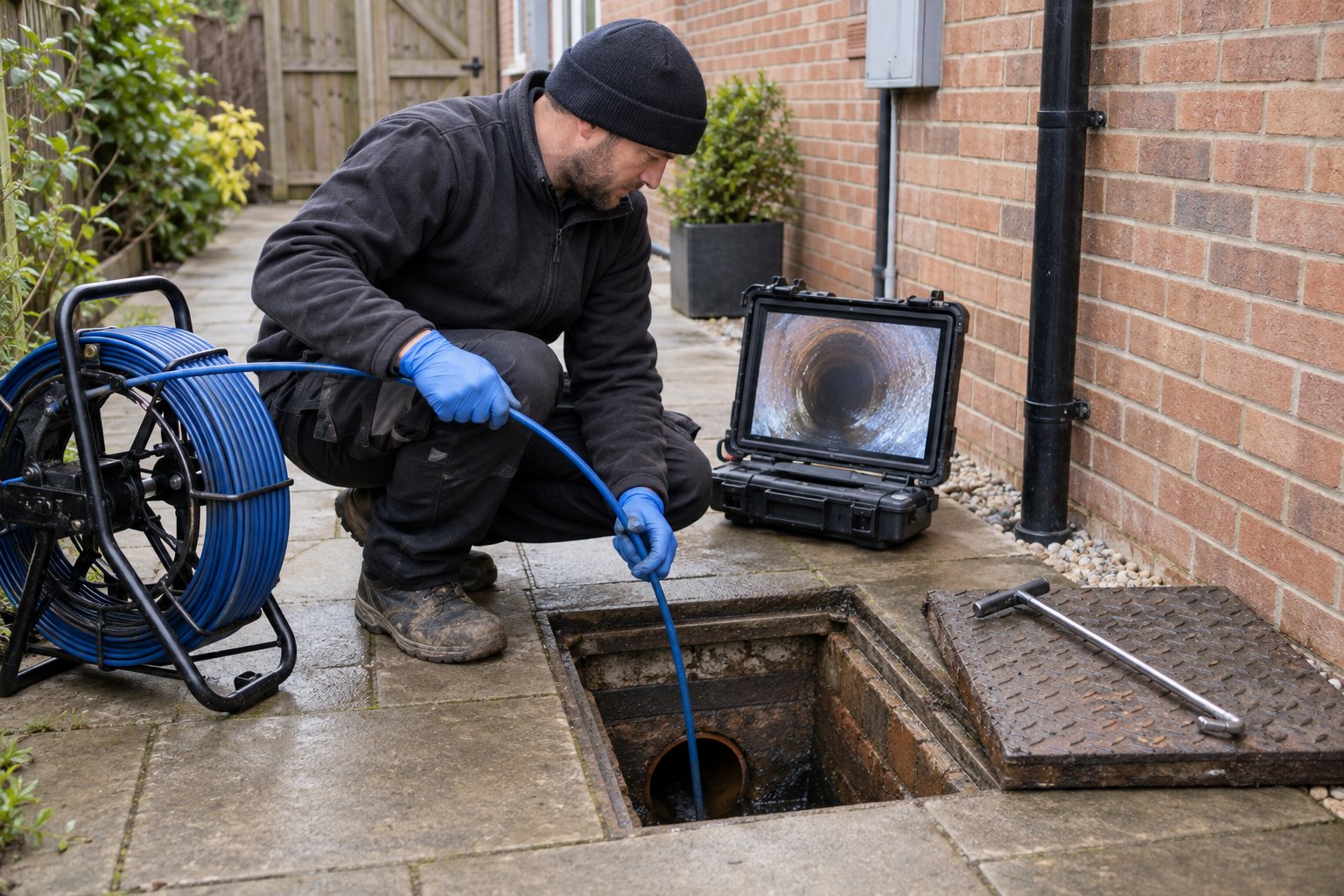
The camera allows a specialist to inspect the internal surface and record defects that cannot be seen from ground level. Subject to access, the survey may establish:
- whether a run appears to be pitch fibre, clay, plastic or another material;
- the approximate diameter and direction of the pipe;
- blistering, delamination and loss of internal bore;
- the location and degree of deformation;
- cracks, holes, displaced joints and open connections;
- root intrusion, scale, silt or other obstruction;
- standing water suggesting a poor fall or local defect;
- a partial or complete collapse; and
- the point beyond which the camera cannot travel.
For a more comprehensive drainage survey, electronic tracing may help plot a route and depth, but it should not be assumed to be included. The buyer should agree the scope before instruction.
Good CCTV report checklist
A useful report should provide enough information for the buyer, surveyor, conveyancer and repair specialist to understand the finding. Ask for:
- ☐ dated video footage, with clear references to each surveyed run;
- ☐ still images of significant defects;
- ☐ the access points and direction of travel;
- ☐ the material and diameter where reasonably identifiable;
- ☐ measured or clearly located observations rather than vague commentary;
- ☐ any sections not inspected and the reason why;
- ☐ a sketch plan or traced layout if that forms part of the instruction;
- ☐ a distinction between urgent defects, maintenance items and observations;
- ☐ repair recommendations that relate to the recorded condition; and
- ☐ confirmation of whether cleaning or jetting was required before the camera inspection.
For a technically detailed investigation, it is reasonable to ask whether defects are recorded using recognised terminology such as BS EN 13508-2 or the WRc Manual of Sewer Condition Classification. The report should still explain the implications in language a homebuyer can understand.
Does finding pitch fibre mean full replacement?
No. Full replacement is one possible outcome, not an automatic one. The right approach depends on the shape, structural condition, route, depth, access and support around the affected pipe.
Where damage is limited and the host pipe remains suitable, a specialist may consider cleaning, local repair, re-rounding followed promptly by a structural resin liner, or another trenchless technique. A properly designed liner can create a new internal surface and reduce the need for extensive excavation.
Those methods are not suitable in every case. Severe deformation, a collapsed section, loss of ground support or an inaccessible connection may make excavation and replacement necessary. The presence of a building, driveway or boundary above the run can also alter the available solution.
Buyers should be cautious of any diagnosis or quotation prepared without adequate evidence. The recorded condition should lead to the proposed remedy—not the other way around. Where the recommended work is substantial, obtaining a clear specification and comparable quotations can help distinguish essential repair from optional improvement.
Who is responsible for the drain?
Condition and ownership are separate questions. In England, a homeowner is generally responsible for the private drain within the property boundary that serves only that property. The relevant sewerage company is normally responsible for shared sewers and lateral drains beyond the boundary, following the transfer of many private sewers in 2011. Exceptions exist, including some private or unadopted systems and newer arrangements.
A CCTV operator can record where a defect appears to be, but that does not necessarily determine legal responsibility. The conveyancer should consider the drainage and water search, title information, property boundaries, seller’s replies and any available sewer records. If a defective section may be part of the public sewer, the local sewerage company should be consulted before private work is arranged.
Will buildings insurance cover a pitch fibre drain?
It depends on the policy, the cause of damage and who owns the affected pipe. Some policies cover accidental damage to underground services for which the policyholder is responsible. They may exclude wear and tear, gradual deterioration, pre-existing problems or pitch fibre specifically.
Do not assume that a future failure will be insured simply because the drain is underground. Before exchange, ask the proposed insurer a clear question about pitch fibre drainage and retain the response. If a defect has already been identified, disclose it accurately when required. The Financial Ombudsman’s published guidance confirms that disputes often turn on the precise policy wording, the nature of the damage and responsibility for the pipe.
What should a buyer do before exchange?
Before-exchange checklist
- ☐ Read the survey wording carefully: is pitch fibre confirmed, suspected or simply not ruled out?
- ☐ Ask the surveyor what evidence led to the recommendation.
- ☐ Agree a suitable CCTV scope and obtain the seller’s permission for access.
- ☐ Request the footage, report, limitations and route information—not only a repair quotation.
- ☐ Give the findings to your chartered surveyor and conveyancer.
- ☐ Confirm which sections are private, shared or the sewerage company’s responsibility.
- ☐ Obtain a written repair specification and, where material, comparable quotations.
- ☐ Check the proposed buildings-insurance terms.
- ☐ Decide whether to proceed, renegotiate or reconsider only after the evidence is assembled.
If repair is needed, the findings may support a price renegotiation, an agreement for work before completion or a planned allowance after purchase. The best solution depends on the transaction. A seller’s promise to “sort the drains” is less useful than a documented scope, competent contractor and evidence of completion.
Should you buy a house with pitch fibre drains?
It can still be a sensible purchase. What matters is whether the drainage is currently serviceable, what work is reasonably foreseeable, who will be responsible and whether that risk is reflected in your budget and offer.
At one end of the scale, CCTV may show a functional run with limited deterioration and no immediate repair requirement. At the other, it may reveal extensive deformation or collapse requiring planned work. Between those positions are many systems that need monitoring, maintenance or targeted repair.
A measured decision combines four forms of advice: the chartered surveyor’s assessment of the property as a whole, the drainage specialist’s internal inspection, the conveyancer’s ownership checks and the insurer’s response. That is more reliable than treating the material name alone as either harmless or catastrophic.
Frequently asked questions
What are pitch fibre drains made from?
Pitch fibre pipes were generally manufactured from wood or cellulose fibre impregnated with coal tar pitch. They were light and economical compared with contemporary clay pipes, which helped make them popular in post-war construction.
How can I tell if a house has pitch fibre drains?
The property’s age and local building history may raise suspicion, and material can sometimes be seen at an accessible inspection chamber. However, a clay channel at the chamber may connect to concealed pitch fibre. A specialist camera survey is usually the best way to identify the accessible underground runs and assess their condition.
Are all pitch fibre drains defective?
No. Pitch fibre has recognised ageing risks, and much surviving pipework has exceeded its often-cited life expectancy of around 40 years. Nevertheless, the degree of deterioration varies. A condition-based inspection is more useful than assuming every system has failed.
Does a Level 2 Home Survey inspect the drains?
A Level 2 survey normally includes a visual inspection of accessible chambers where covers can be lifted safely without damage. It does not include technical testing or a CCTV inspection of all buried pipework.
Does a Level 3 Building Survey include CCTV?
Not as standard. A Level 3 survey can include a more detailed consideration of drainage and observation of normal operation where possible, but it remains a non-destructive building inspection. A CCTV survey is a separate specialist investigation unless expressly agreed otherwise.
When should I arrange a CCTV drain survey?
It is particularly sensible before exchange when pitch fibre is identified or reasonably suspected, the normal inspection is restricted, drainage symptoms are reported, accessible defects are visible, or leaking drains may be relevant to cracking or ground movement.
Can pitch fibre drains be repaired without digging them up?
Sometimes. Re-rounding and lining, local repairs or other trenchless methods may be suitable where the pipe and surrounding ground can support the proposed system. Serious collapse, severe deformation or other constraints can require excavation. A specialist should base the method on CCTV evidence and site conditions.
Should I withdraw from a purchase if pitch fibre is found?
Not automatically. First establish the condition, extent, ownership, repair options and insurance position. A clear report and appropriate quotations allow you to judge the risk, budget properly and negotiate from evidence.
Independent advice before you commit
A home survey should help you understand the whole property, not simply attach a frightening label to one buried component. Harding Chartered Surveyors can inspect the visible and accessible elements, explain the significance of any drainage warning signs and advise when a specialist CCTV investigation is appropriate. If you are buying in London or the South East, request an instant survey quote and choose the level of inspection that suits the property.
This article provides general information for UK homebuyers and is not a substitute for a property-specific inspection or specialist diagnosis.