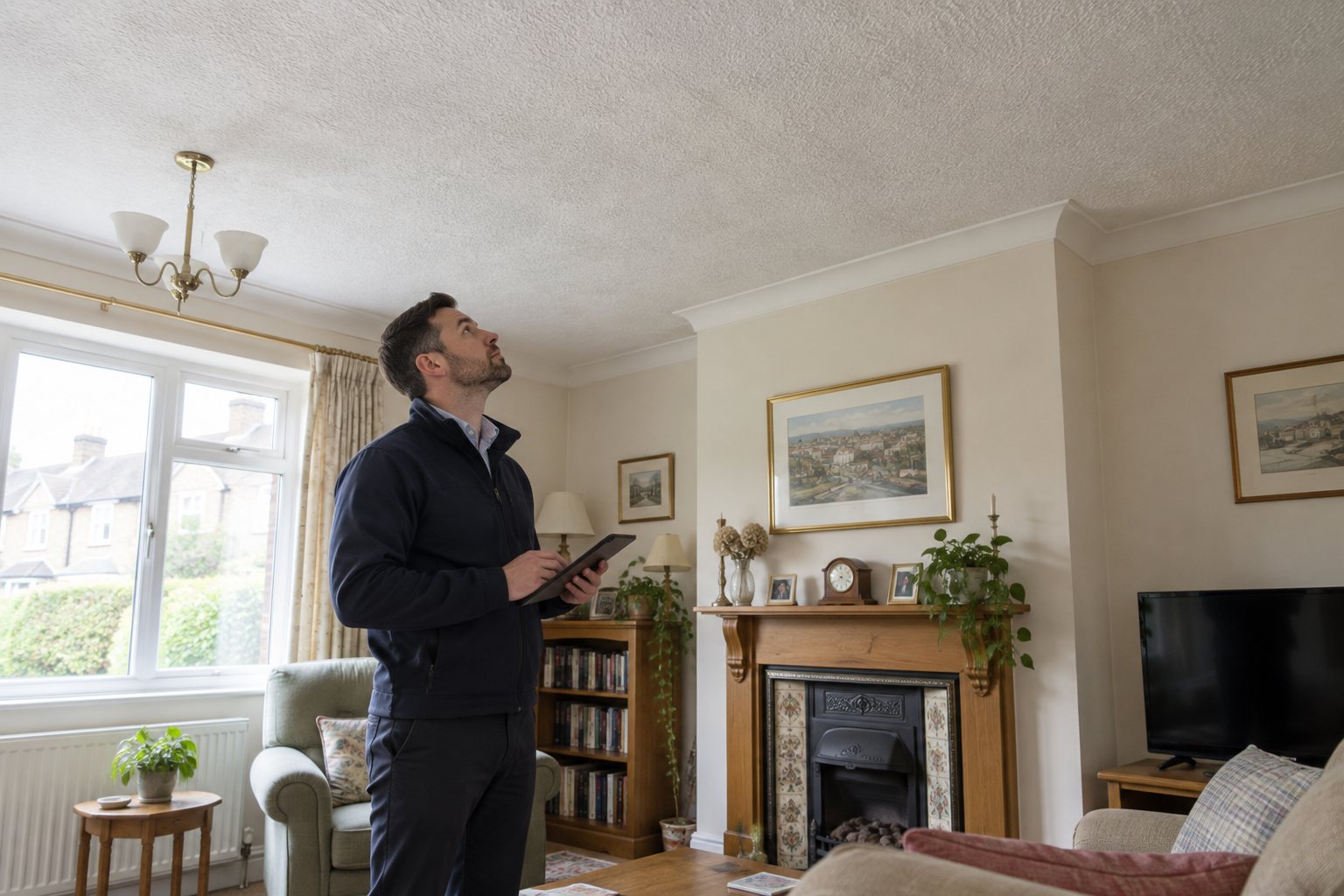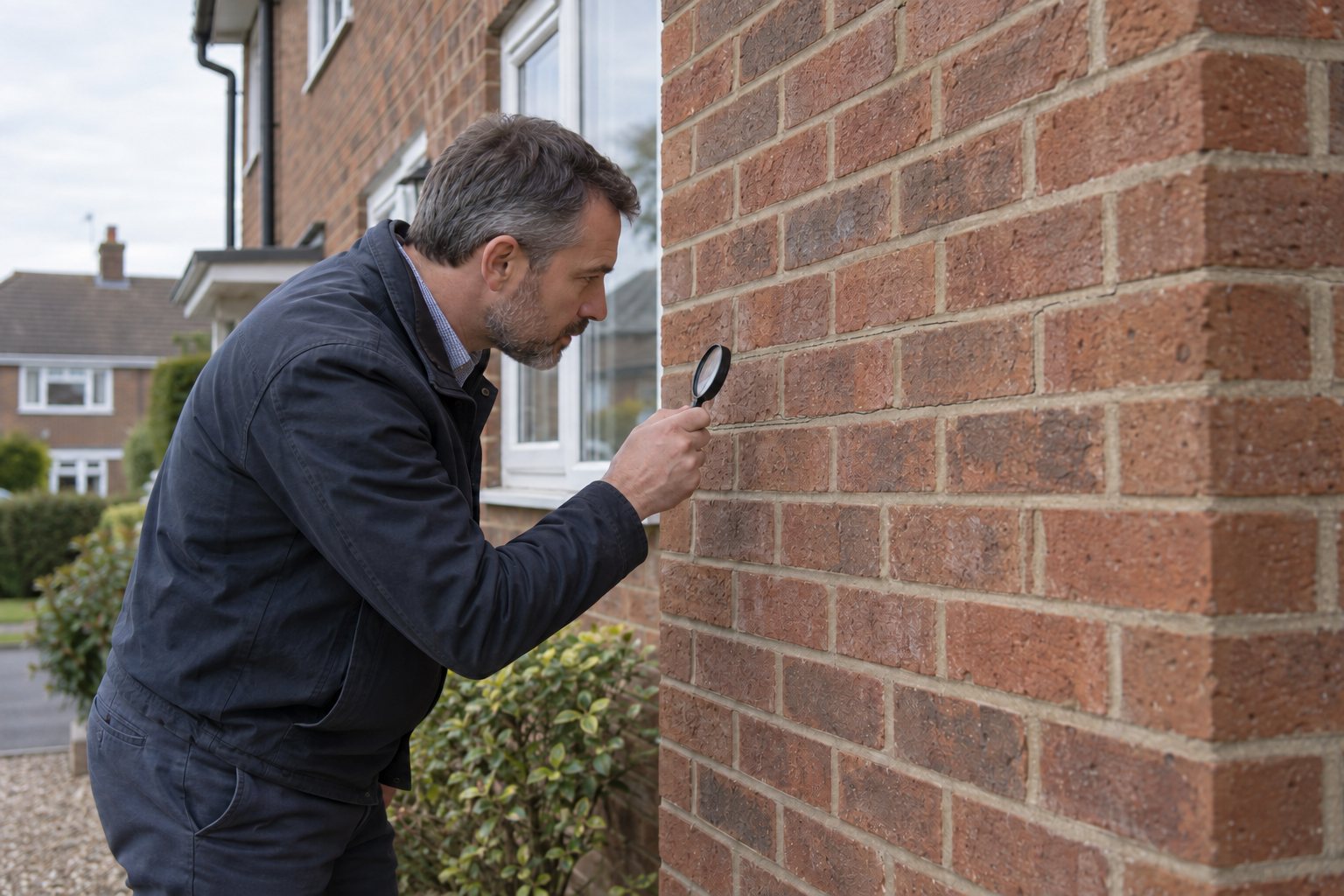

Finding Finlock concrete gutters during a building survey does not necessarily mean you should abandon the purchase. It does mean that their condition, repair history and effect on the surrounding wall and roof deserve careful attention. A chartered surveyor can identify the gutter system, look for visible leakage, damp, condensation and deterioration, and advise whether further investigation is sensible. However, a normal pre-purchase survey cannot guarantee the condition of a concealed lining or every embedded part of the concrete sections.

In short
- Finlock gutters are precast concrete sections built into the eaves of some post-war UK homes.
- They close the top of the wall cavity as well as collecting rainwater.
- Possible issues include open joints, failed linings, leaks, cold bridging and damage to nearby finishes.
- Some installations also form lintels above windows, so the construction must be understood before major alteration.
- Visible warning signs can be reported in a survey, but concealed defects may require a specialist inspection.
- The right response depends on the actual condition: maintenance, lining and replacement are not interchangeable solutions.
What are Finlock concrete gutters?
Finlock concrete gutters are built-in rainwater channels positioned along the eaves. Rather than being a separate plastic or metal gutter fixed to a timber fascia, the original system uses short precast concrete sections laid in a continuous run at the top of the external wall. One trough forms the visible gutter, while another part closes or crosses the wall cavity.
They are most often associated with housing built between about 1950 and 1970, although age alone should never be used to identify a system. The Concrete Society notes that individual sections can vary in length and that, in some installations, the units were filled with concrete over openings to form a lintel. That detail matters: what appears to be only an old concrete gutter may also be part of the construction above a window.
Finlock was a practical post-war solution, but it behaves differently from a modern lightweight uPVC or aluminium gutter. It is integrated with the building fabric, so a fault can affect more than rainwater disposal. Water, heat loss and movement at the eaves can all become relevant.
Why might a surveyor flag a Finlock gutter?
A surveyor does not normally raise the issue simply because concrete guttering exists. The important questions are whether it is working, whether there is evidence of deterioration and whether previous alterations were properly designed and executed.
Open joints and failed linings
The system is assembled from multiple concrete sections. If joints open through ageing, movement or weathering, rainwater may escape rather than reaching the downpipe. Some installations were sealed at the joints; others have a continuous lining. Older repairs can include bitumen-based coatings or other applied products, and these may eventually crack, detach or conceal local defects.
A leak can stain the outer wall, saturate brickwork or render and, depending on the arrangement, allow moisture towards the cavity. A dry inspection day does not prove that the gutter is watertight, so historic staining can be as informative as active dripping.
Cold bridging and condensation
Concrete conducts heat more readily than an insulated cavity. Where the gutter crosses or bypasses the top of the cavity, it can create cold bridging — sometimes called thermal bridging — at the junction between the wall and ceiling. In cold weather, the internal surface may become cool enough for moisture in indoor air to condense.
This can produce high-level damp patches, discoloured decoration or mould near the eaves. Crucially, condensation and penetrating damp are not the same defect. They can occur together and look similar, but successful repair depends on identifying the moisture source rather than treating the visible mark alone.
Cracking, spalling and previous alteration
The surveyor will also consider cracks, displaced sections, surface breakdown and signs of repeated patching. Concrete can deteriorate locally, while nearby roof tiles, pointing, render, brickwork and window heads may reveal the consequences of poor rainwater disposal.
If an earlier gutter replacement has been carried out, the surveyor may look at the new fascia, roof edge and outlet arrangement. Cutting back or altering an integrated system without addressing the original lintel and cavity details can create future issues even if the new gutter appears tidy from ground level.
What warning signs may be visible?
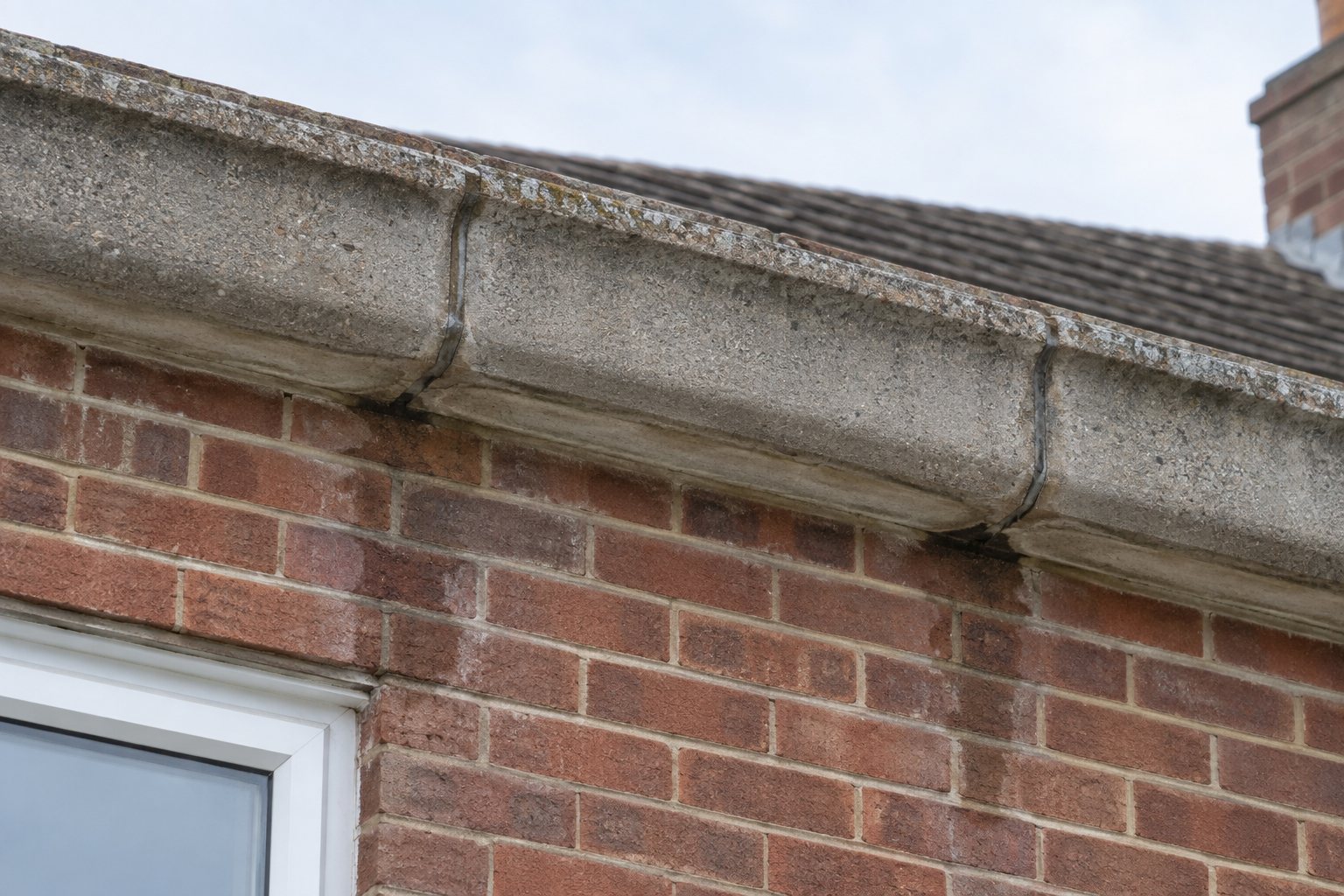
The following signs justify a closer look, but none proves the full condition of the system by itself:
- dark or green staining below the joints between concrete sections;
- peeling paint, damaged plaster or mould at the top of external walls;
- water marks above or beside windows;
- cracked sealant, fractured coatings or sections that appear misaligned;
- overflowing during rain, vegetation in the channel or blocked outlets;
- spalled concrete, loose fragments or damaged adjacent masonry;
- an irregular roof edge following an earlier conversion;
- evidence that one elevation has been altered while adjoining or neighbouring runs remain original.
Homeowners should not lean from an upper window or climb onto a roof to investigate. Safe access is part of a professional inspection, and a Roof Survey may be appropriate when the gutter and roof-edge detail are the principal concern.
What does a chartered surveyor check?
During a suitable pre-purchase survey, the surveyor will normally assess the visible and safely accessible parts of the rainwater system and the building around it. The precise scope depends on the agreed service and access available on the day.
Typical observations include:
- the apparent type and layout of the concrete gutter;
- visible joints, lining edges, outlets and downpipes;
- whether the channel appears blocked, damaged or poorly aligned;
- signs of present or historic water penetration externally and internally;
- high-level condensation patterns and local mould growth;
- deterioration to masonry, render, roof tiles and window heads;
- evidence of lining, coating, partial replacement or other repair;
- whether an alteration may have affected a lintel, cavity closure or roof support;
- documents supplied by the seller, including invoices, specifications and guarantees.
A RICS Level 3 Building Survey is the most detailed standard home survey and is often the more suitable choice for an older, altered or visibly defective house. It can explain likely causes, consequences and repair priorities. It remains, however, a non-destructive inspection unless an additional arrangement has been expressly agreed.
What a normal survey cannot confirm
The lining may be concealed by standing water, debris or a previous coating. Embedded reinforcement, the inner face of the sections and the exact construction above openings are also unlikely to be visible. A surveyor will not normally remove roof tiles, cut through a liner, dismantle the fascia or open the wall during an ordinary pre-purchase inspection.
Weather is another limitation. A gutter may perform differently during prolonged or wind-driven rain than it does during a brief shower. Moisture readings and visible staining help form a professional opinion, but they are evidence to interpret, not a watertightness guarantee.
Where visible defects suggest that concealed elements may also be affected, the appropriate advice may be a targeted investigation. Harding’s Specific Defect Report can focus on one known concern, although a roofing contractor, specialist gutter installer or structural engineer may also be needed depending on the question.
Maintenance, lining or replacement?
There is no universal best repair for every Finlock gutter. The following comparison is a starting point rather than a specification.
| Possible approach | When it may be considered | Important questions |
|---|---|---|
| Cleaning and local gutter maintenance | The system is broadly serviceable but has debris, a restricted outlet or a genuinely local joint defect | Is the underlying lining sound? Is the leak truly local? Will a patch accommodate movement? |
| Continuous proprietary lining | The concrete is sufficiently stable and the main problem is loss of watertightness | How are joints, outlets and ends detailed? What preparation is required? Does the proposed lining have suitable evidence and a meaningful guarantee? |
| Site-formed aluminium guttering | A continuous insert is technically suitable for the existing profile | Can adequate falls and outlet capacity be achieved? How will thermal movement and junctions be handled? |
| Conversion to a conventional gutter | The original system is extensively defective or a wider roofline upgrade is justified | Do sections act as lintels? How will the cavity, insulation, fascia, soffit and roof edge be reconstructed? Are approvals or structural input required? |
A low quotation is not necessarily good value if it deals only with the visible channel and ignores cold bridging, wet masonry or structural integrity. Conversely, complete gutter replacement may be disproportionate where an independent inspection finds a stable system with a limited, repairable defect.
Questions to ask about previous work
If the seller says the gutters have been repaired, ask for more than a verbal assurance. Useful evidence includes:
- the contractor’s invoice and full scope of work;
- the product or system used and the manufacturer’s installation requirements;
- photographs taken before, during and after the work;
- a transferable guarantee and its exclusions;
- any structural design or Building Control information relating to removal or alteration;
- confirmation of how the cavity, insulation and window-head details were treated;
- evidence that internal water damage was allowed to dry and its cause was resolved before redecoration.
Fresh paint is not proof that a moisture problem has been cured. It may be entirely innocent, but it makes supporting documents and a careful inspection more valuable.
Before-exchange checklist for buyers
- ☐ Confirm whether the property has original, lined, partly replaced or fully converted Finlock guttering.
- ☐ Choose an appropriate property survey rather than relying on the lender’s valuation.
- ☐ Tell the surveyor about any damp patches, seller statements or repairs that particularly concern you.
- ☐ Ask the seller for invoices, specifications, photographs and transferable guarantees.
- ☐ Obtain a targeted inspection if the survey cannot resolve an important concealed issue.
- ☐ Request comparable written quotations where substantial work is anticipated.
- ☐ Check that quotations include access, scaffolding, outlets, fascia and soffit work, making good and associated damp repairs.
- ☐ Ask your conveyancer to review relevant approvals, guarantees and responsibility for shared roofline details.
- ☐ Base any price negotiation on documented defects and realistic work scopes, not on the name “Finlock” alone.
- ☐ Keep a contingency for conditions that can only be confirmed after opening-up.
Should you buy a house with Finlock gutters?
It can still be a perfectly reasonable purchase. The decision should turn on the condition of this particular system, evidence of water damage, the credibility of past repairs and the cost and disruption of any recommended work. A serviceable lined gutter with sound surrounding fabric is a different proposition from an actively leaking run with poorly executed alterations and concealed uncertainty.
The survey should help you put the issue in proportion alongside the rest of the property. If further work is needed, obtaining evidence before exchange allows you to budget, negotiate or reconsider while you still have choices.
Frequently asked questions
Are all Finlock concrete gutters defective?
No. They have recognised vulnerabilities, but existence is not the same as failure. Condition, exposure, maintenance, lining and previous alterations vary considerably. The inspection should focus on performance and evidence rather than assuming that every system needs immediate replacement.
Can a Finlock gutter be repaired without removing it?
Sometimes. Local maintenance or a continuous lining may be appropriate where the concrete and surrounding construction are suitable. The leak route, joints, outlets, falls and substrate condition need to be understood first. Repeated patches without diagnosis can postpone rather than solve a problem.
Does gutter lining cure cold bridging?
Not necessarily. A lining is primarily intended to manage rainwater. It may stop leakage if correctly specified and installed, but it does not automatically remove the thermal bridge created by concrete crossing the wall. Condensation risk may require separate consideration of insulation, ventilation and internal humidity.
Are Finlock gutters structural?
Some installations incorporate units that form lintels over openings; others have different details. It is unsafe to assume either that every section is loadbearing or that none is. Major cutting or replacement should be based on an understanding of the actual construction and, where appropriate, structural advice.
Can a surveyor confirm that the lining is watertight?
A surveyor can report visible condition, signs of leakage and risk, but a normal home survey is not a watertightness test. Concealed or intermittent leaks may not be apparent, particularly in dry weather. Further inspection may be recommended where the evidence warrants it.
Should cavity-wall insulation be installed below Finlock gutters?
Government-commissioned research identifies faulty Finlock gutters as an issue requiring assessment before cavity insulation, because a deteriorated lining can admit moisture and the concrete can create a cold bridge. The suitability of insulation should be assessed for the whole wall, exposure and construction, not decided from the gutter alone.
Will Finlock gutters affect my mortgage or insurance?
There is no single industry-wide answer. A lender or insurer may ask for more information if there is active leakage, significant deterioration or unverified structural alteration. Provide the survey, specialist findings and repair documents requested rather than assuming the material itself makes the house unacceptable.
What is the best survey for a house with Finlock gutters?
For an older or altered house, a Level 3 Building Survey will usually provide the fullest standard assessment of the property as a whole. If the only concern is a known gutter defect, a targeted defect or roof inspection may be proportionate. Discuss the property and your concerns with the surveyor before instruction.
Get independent advice before you commit
Finlock gutter problems should be diagnosed in the context of the whole building, not treated as a sales label or a reason for automatic alarm. Harding Chartered Surveyors provides independent Level 3 Building Surveys, Roof Surveys and Specific Defect Reports across London and the South East. We can explain visible defects, inspection limitations and sensible next steps so that you can make an informed purchase decision.
This article provides general information for UK homebuyers and is not a substitute for a property-specific inspection or specialist diagnosis.